The Mets Aren’t Just Losing — They’re Losing Wrong

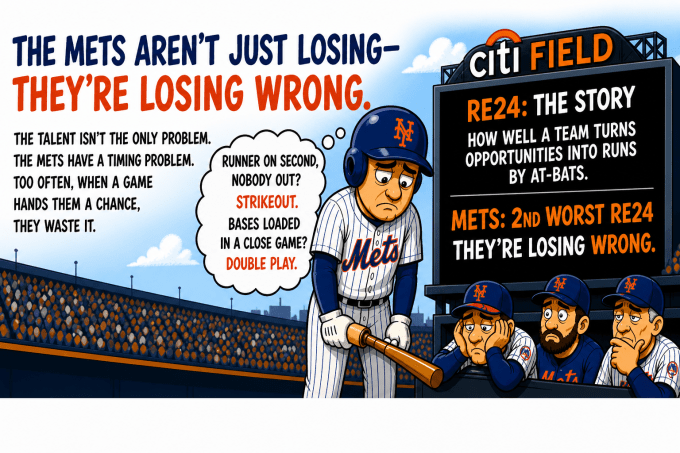
The New York Mets have a talent problem. But a single baseball stat reveals something more painful — they have a timing problem. Too often this season, when a game hands them a chance to do damage, they waste it. Runner on second, nobody out? Strikeout. Bases loaded in a close game? Double play.

The statistic that captures this is RE24.

RE24 measures how well a team turns opportunities into runs. Right now, the Mets have the second-worst RE24 in baseball.

According to FanGraphs on May 5, 2026, the Mets team RE24 was -36.36. Only the Giants had a lower one. In contrast, the Yankees lead the majors with a 44.70 RE24 score.

It’s not just coincidence that the Yankees lead the AL East while the Mets are last in the NL East and the Giants are next-to-last in the NL West.

So what is RE24?

At any moment in a game, there are 24 possible base-out situations from no outs, no runners on base to two outs, bases loaded. Each carries an expected number of runs a team should score in a particular base/out instance before the inning ends— a concept Tom Tango developed and popularized.

For example
Nobody on, nobody out → ~0.5 runs
Bases loaded, nobody out → ~2.33 runs
Runner on second, two outs → ~0.33 runs

Be aware that when a plate appearance makes a scoring situation worse, it lowers a team’s RE24.

RE24 asks a simple question: when the situation changes, did you add value or give it away? Over time, that answer becomes a record of execution.

Mediocre production. Outsized damage.

The Mets aren’t among the worst teams at getting on base in these spots. Their average and on-base percentage with runners on rank in the low 20s league-wide — poor, but not disastrous.

This isn’t just lack of talent. It’s how the at-bats end.

The Mets are “losing wrong” because they aren’t just losing—they are wasting their own chances. Even when they get players on base, they constantly make the worst possible outs—like hitting into double plays—which kills their momentum and stops them from scoring. Basically, they are losing games because too often they hurt their own chances every time the opportunity presents itself for them to gain on their opponent.

Why this matters

Underperforming teams don’t take advantage of chances.

At 13–22, the Mets are not just struggling — they’re consistently missing out on opportunities.

That’s harder to watch than being outplayed, because the runs you hoped would score never make it to the scoreboard.
Few Teams Disappoint Like the Mets

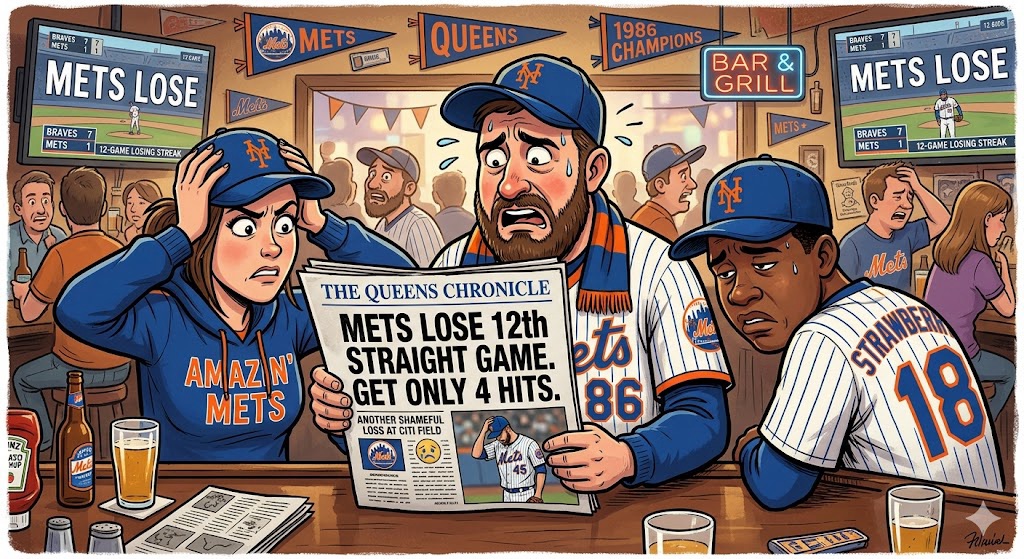
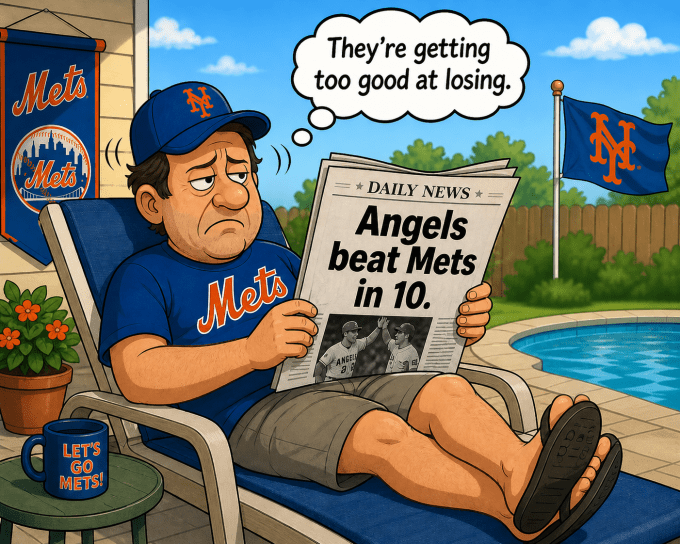
Sports cartoons often look simple at first glance—a single image, a short line, and a quick reaction. But the best ones do more than just show a moment; they capture a feeling that fans recognize right away. This post takes a closer look at the above cartoon centered on a New York Mets fan and asks a few key questions: What is the cartoon really saying? Why doesn’t it feel traditionally “funny”? And how does it tap into the shared experience of being a fan?

More importantly, this post aims to move beyond just explaining the cartoon and help readers connect to it. Instead of just pointing out what’s in it, the cartoon explores how the scene mirrors the routine, emotions, and expectations that come with following a team over time. By the end, the goal is for readers not just to understand the cartoon—but to recognize themselves in it.

The cartoon shows a moment that many New York Mets fans will recognize almost instantly. You sit down to relax—maybe by the pool, maybe on the couch—and check the score. The headline reads: “Angels beat Mets in 10.” You don’t react with shock. You don’t even get angry. You just shake your head, because you’ve seen this kind of game before.

That’s what makes the cartoon feel so real. It’s not loud or dramatic. The fan doesn’t throw the paper or yell at the sky. Instead, he thinks, “They’re getting too good at losing.” And if you’ve followed this team long enough, that thought might feel uncomfortably familiar. It’s not really a joke—it’s more like something you catch yourself thinking after one too many games that slip away late.

The extra-innings detail matters. These aren’t blowouts you can ignore by the fifth inning. These are the games that keep you watching, keep you hoping. The Mets are right there, one hit or one pitch away—and then somehow, it goes the other way. Again. After a while, you stop being surprised. You start expecting it.

That’s why the cartoon isn’t laugh-out-loud funny. If anything, it feels too accurate to laugh at. It captures that slow, worn-down feeling that comes from sticking with a team through repeated letdowns. You’re still watching, still hoping—but a part of you is already bracing for how it might end.

In that sense, the cartoon works as a kind of quiet satire. It flips what we expect—teams are supposed to get better at winning—and suggests the opposite. But it does so gently, without exaggeration or bite. Instead of mocking the fan, it invites you to see yourself in him.

And that’s really the point. The cartoon isn’t just showing one fan’s reaction—it’s reflecting a shared experience. If you’ve ever followed a team long enough, you recognize the pattern.

You’re not just looking at the cartoon. You’re sitting in that chair.

Are you?

Second in Spending, Last in Results

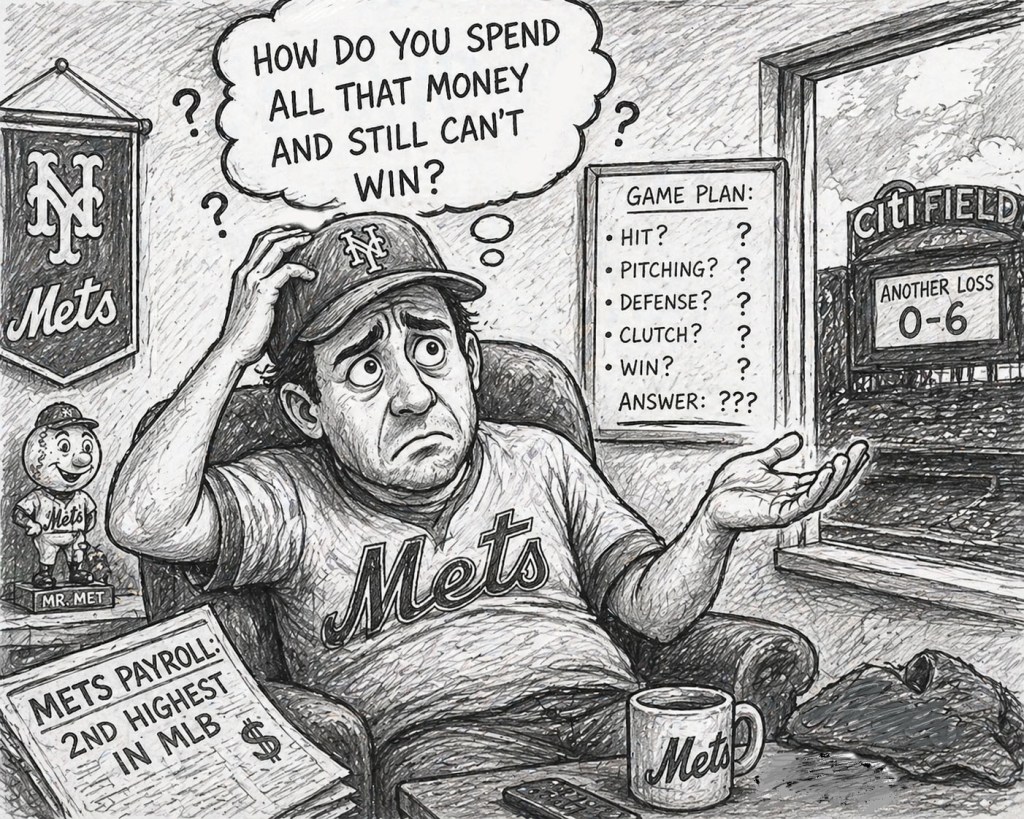
The current Mets are the most puzzling team I have ever seen. Their 2026 payroll of $382,960,938 is the second-highest in baseball, yet they have the worst won-lost record (10-21).

Mets Lost in a Losing Streak

In 2025 in the first 31 games they were 21-10, the exact opposite of what they are this season.

They’re bad even with Juan Soto and Bo Bichette, two of baseball’s better hitters. That’s one reason why the team is so puzzling.

One of the biggest pieces of the puzzle is newcomer Bo Bichette, whom the Mets are paying $42,000,000 this season, and who is hitting .230. In his first 31 games last season with the Brewers he hit .293.

Does switching leagues make that big a difference?

It might because Pete Alonso is hitting just .198 with the Orioles in their first 31 games; whereas, as a Met in 2025, he batted .343.

Mets Losing Streak Worsens

Playoff Chances Fading Fast

Keeping fingers crossed that season’s not over

The Mets have had a tough season, and it seems like they’re still figuring things out. The changes they made in the off-season seem to have thrown them off, especially in the infield and at the plate. Someone needs to rally the team and get everyone pumped up enough to defeat their foes.

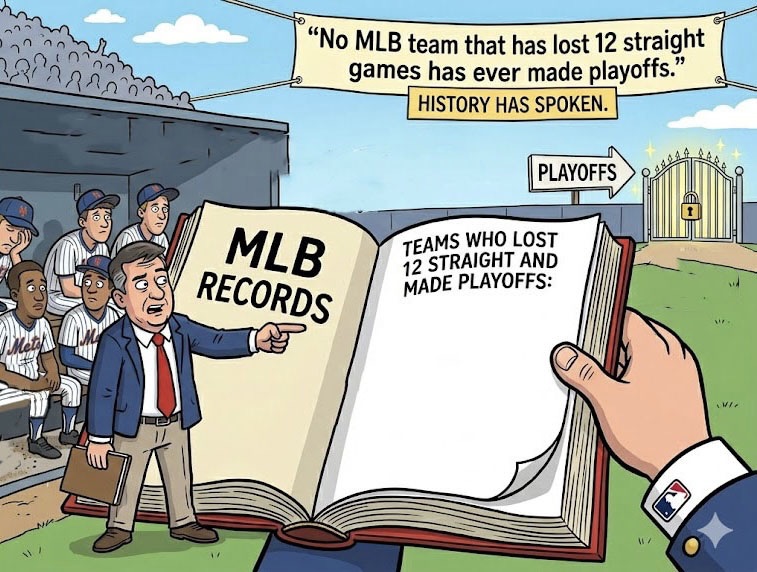
Can Mets be the first? Hope so.

Since 2000, teams have lost 12 games 17 times. Four teams have done it twice, the Mets one of them, last doing it in 2002. That season, they finished in last place, 26.5 games behind the Atlanta Braves.

The Mets are struggling to end their losing streak.

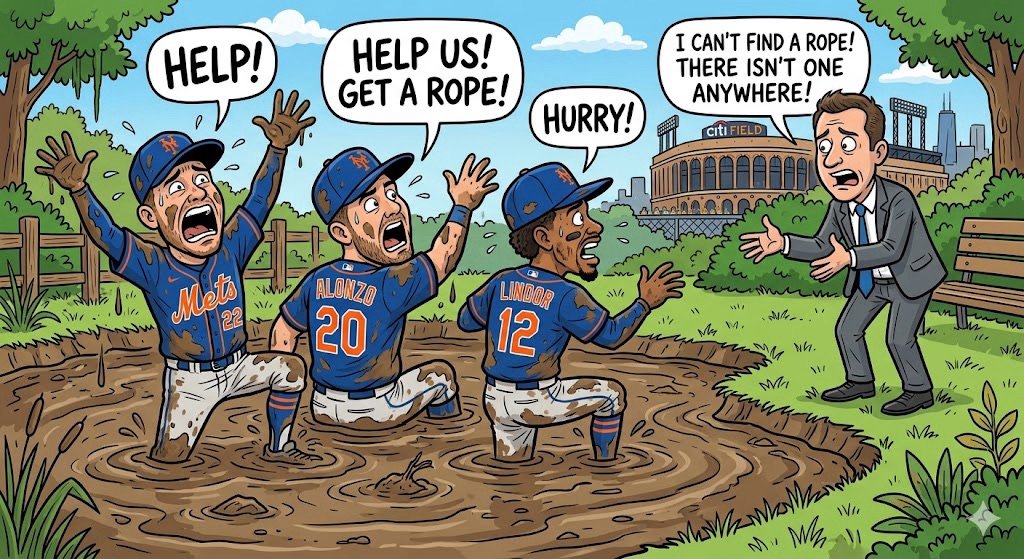
The “quicksand” imagery encapsulates the current mood of the 2026 season for a fanbase that has traded high expectations for high anxiety. Watching a roster that should be dominant—led by Francisco Lindor and Juan Soto bolstered by the addition of Bo Bichette and Freddy Peralta—struggle to stay afloat during this April slide feels like another nightmare.

The presence of Pete Alonso in the mud, despite his actual departure to Baltimore, highlights the lingering feeling that the team is still searching for its power identity. The man in the suit shouting that he “can’t find a rope” symbolizes the Mets’ leadership.

It’s a biting commentary that, despite all the data and resources at their disposal, the Mets are once again finding creative ways to get stuck.