New York Mets All-Star Game Participation

This season, three Mets have been selected for the 90th All-Star game: Jacob deGrom, Jeff McNeil, and Pete Alonso, which is more than in 2017 and 2018 combined. In 2017 and in 2018 only one Met was chosen. Further, though McNeil has played multiple positions this season, he is listed on the All-Star roster as a second baseman, a position he has played only 22 times: in 2019, he has primarily played in 2019 in the outfield.

Since the Mets began in 1962, the team’s players have been selected for the All-Star team 121 times. The first Mets player selected, in 1962, was Richie Ashburn. In that year there were two All-Star games, one on July 10, which the National League won, and the other on July 30, which the American League won. Ashburn did not start in either game. Willie May started in centerfield in both games. He did not play in the first game, but in the second game, as a pinch-hitter, he singled in the seventh inning and scored a runner. 1962 All-Star Game Box Score by Baseball Almanac

Only four Mets have started an All-Star game in centerfield: Willie Mays in 1972, Lance Johnson in 1996, and Carlos Beltran twice, in 2007 and 2008. In the 1996 game, Johnson had 3 hits in 4 at-bats. That season, he led the National League in hits with 227, in 1996, in singles with 166, and in triples with 21. Despite his great season with the Mets, in August 1997 they traded him to the Cubs along with Mark Clark and Manny Alexander for Brian McRae, Mel Rojas, and Turk Wendell.

Besides Beltran, only 28 other Mets were selected for the All-Star game more than once while playing for the Mets. Leading the group is Tom Seaver who appeared in nine games. Among the others selected multiple times are Mike Piazza, Darryl Strawberry, and David Wright, all selected seven times.

The most Mets selected in one season to the All-Star team is six. That occurred in 2006. Somewhat surprisingly, during the 1969 season only three Mets made the All-Star team — Cleon Jones, Jerry Koosman, and Tom Seaver and, the following season, only two made it — Bud Harrelson and Tom Seaver.

Finally, whereas four Mets pitchers have started an All-Star game, only one first baseman did, Keith Hernandez, one second baseman, Ron Hunt, two shortstops, Bud Harrelson, and Jose Reyes, and two third basemen, Howard Johnson and David Wright.

The table below show how many times since 1962 a Mets player has started in an All-Star game by position. The “Different” column indicates how many different players started. For example, though Mets pitchers have been the starters in All-Star games four times, one pitcher (Dwight Gooden) started twice. The other two were Tom Seaver and Matt Harvey.
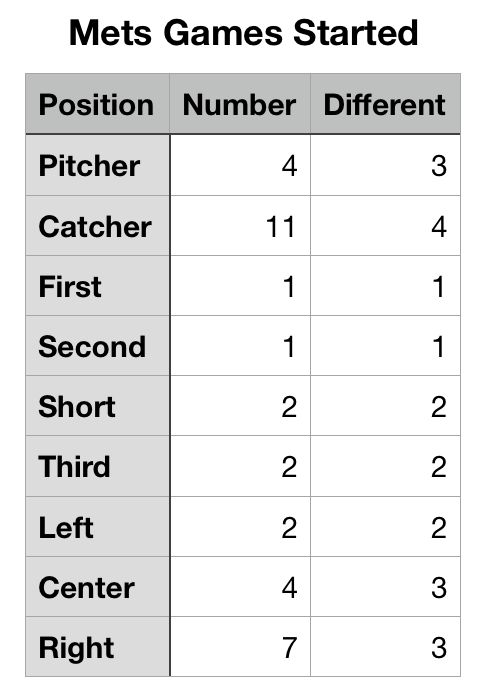
All-Star Games in which Mets player started, by position

Statcast School: Hardest Hit Ball to 3B

Source: Pixabay

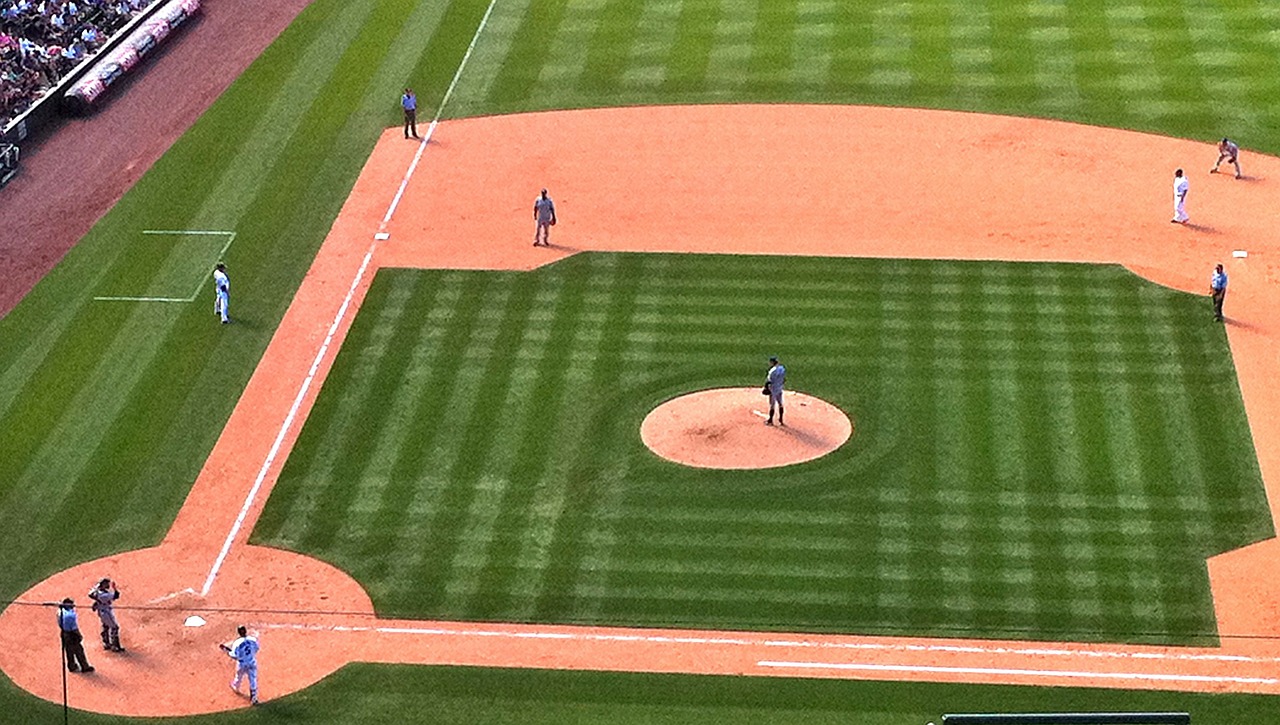
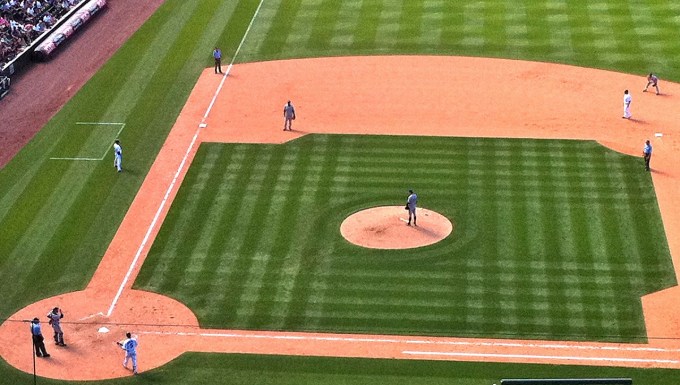
When a third baseman is playing close to the bag, he is not much more than 90 feet away from the batter. Only the pitcher, and sometimes the first baseman, is closer. A ball hit to third base can exceed 100 miles per hour. At 100 mph, that is 146.7 feet/second, so it will reach the third baseman in fewer than one second. Not much time to react.

Who has hit the hardest ball (ground ball or line drive) to third base this season? Here is how to find that out.

Statcast Search Selections
1. Batted Ball Type: both Line Drive and Ground Ball
2. Batted Ball Location: Third Base
3. Season Type: Regular Season
4. Season: 2019
5. Player Type: Batter
6. Metric Range: Exit Velocity
7. >=: 114
8. Min # of Total Pitches: None
9. Min # of Results: None
10. Group By: Player Name
11. Sort By: Pitches
12. Sort Order: Desc
13. Min PA: None
14. Change Total Pitch Parameters: None

Results
Two batters qualified: Maikel Franco and C. J. Cron. On April 25, 2019 Franco hit a 114.1 mph per hour line drive at Marlins third baseman Martin Prado. The ball traveled 138 feet. On June 23, 2019, Cron hit a 114.7 mph grounder at Royals third baseman Hunter Dozier. Its distance: 122 feet. Thus so far this season (as of games thru June 23), C. J. Cron has hit the hardest ball to third base.

Two Research Questions (Use Statcast to find answers)
As of games through June 23, 2019, how many batters hit a ball at least 114 mph? Who hit the one with the greatest exit velocity? How fast was it?

Statistical Investigation: Jeurys Familia

A FanGraphs article in 2017 titled “The Death of the Sinker” ended with this quote: “I don’t think the sinker’s gone,” [Jared] Hughes said. “I think teams might be trying to find a way to focus on velocity, but in my opinion, the sinker is the best pitch in baseball.”

This season, for Mets reliever Jeurys Familia, that has not been the case. Though his most-used pitch has been the sinker, thrown 47.1% of the time, it has not been his most effective one.

Stat Fact: His ERA is 7.81. That is the 5th highest ERA in Major League Baseball out of 167 qualifying relievers. Plus his BB/9 of 6.83 is also 5th highest in the majors.

Opposing batters are hitting .333 against his sinker, much higher than in the previous four years. (It was .204 in 2015). That is almost 40 points higher than the 2019 League average against sinkers of .294.

Stat Fact: Familia ranked 39th in opposing batting average among relievers who had thrown sinkers to at least 25 batters.

And since 2017, when Familia has thrown his sinker opposing hitters SLG has increased every year from .265 to .377 to .521. That is 256 points. Further, when the first pitch in an at-bat is a sinker, they are hitting .556.

Stat Fact: Familia also ranked 39th in slugging percentage among relievers who had thrown sinkers to at least 25 batters.

Compounding Familia’s problems is that fact that opposing batters have gotten more extra-base hits off his sinker, six, than his other three pitches combined.

Historically, the sinker has been known as the ground ball pitch. As Kepner wrote in his book, K: A History of Baseball in Ten Pitches, “Its allure was efficiency, not force. Throw it low for ground balls.”

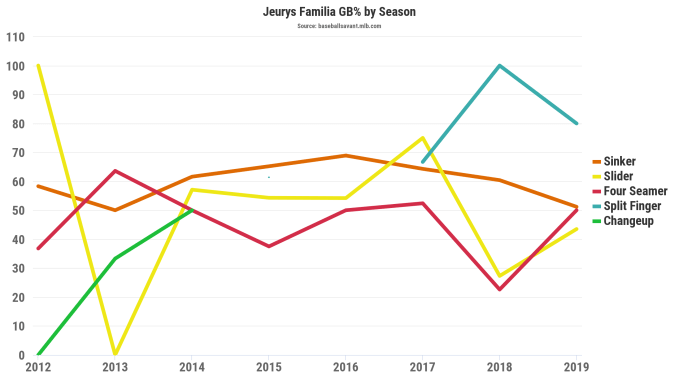
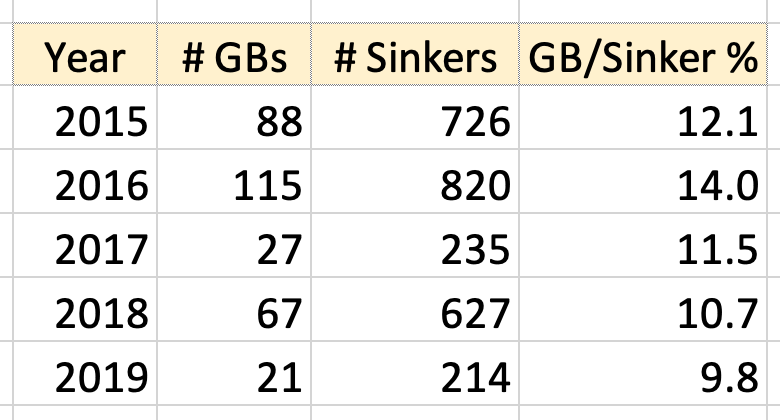
Familia has even had trouble doing that. Since 2016, the percent of his sinkers that have resulted in ground balls has steadily declined.

% of Jeurys Familia’s sinkers that resulted in ground balls

Surprisingly this season, as the GB% for his sinker has dropped, for his four-seam fastball — a pitch he has thrown only 12.9% of the time, it has increased. However, opposing batters are hitting .333 when he throws a four-seamer, the same opposing BA as for his sinker.

Source: Baseball Savant

Team Options

  • Reduce the number of sinkers Familia throws so it is no longer his main pitch. This season, against his slider batters are hitting .212, but he has only thrown it 27.9% of the time. Increase its usage.
  • Have him throw his four-seam fastball in place of his slider.
  • Determine whether a physical issue might be either causing or contributing to his pitching problems.

Update: The Mets have placed Familia on the 10-day injured list with a Bennett lesion for the second time this season. According to the book Baseball Sports Medicine, it is an “overuse” injury that can affect both shoulders and elbows. “Nonoperative treatment” includes rest, activity modification, and rehabilitation.” For more information on this injury and Familia’s earlier placement in May on the injured list, see Anthony DiComo’s mlb.com article.

Jacob deGrom’s changeup not working as well as in 2018

Jacob deGrom, in his first pitch to a batter, should not throw a changeup.

So far in 2019, seven times Jacob deGrom has thrown a changeup as the first pitch. Six of those times the batter got a hit (.857 average). All the hits were singles. Statcast Search

In contrast, in 2018 deGrom threw only 12 first-pitch changeups. Two resulted in hits. Both were singles for a .167 average. Statcast Search

This season, when any Mets pitcher have thrown an off-speed pitch as the first one, they fared much worse than the League average, opposing batters hitting .350 against them. Statcast Search

The problem is not just the Mets’. When any MLB pitcher started a pitch count with an off-speed pitch, opponents have hit .301 (188 for 625). Statcast Search

Jacob deGrom’s problems are not just with first-pitch changeups. This year, he has thrown a changeup as the last pitch 37 times. Eleven of them resulted in hits for a .297 opponents’ batting average. His problems with his changeup are surprising given that in 2018 deGrom was said to have the fourth-best changeup in Major League Baseball.

As a team, the Mets rank eighth-worst, 18 points above the League average, with opponents hitting their last-pitch, off-speed pitches at a .240 pace (93 for 387). Statcast Search Tampa Bay has the best team average, .167, more than a hundred points lower than the Mets.

League-wide, when an off-speed pitch is thrown as the last pitch, opponents are hitting .222 (1831 for 8258). Statcast Search

The Mets starter for whom an off-speed pitch has been the best out-pitch is Noah Syndergaard. Of the 67 he threw — all changeups — that ended an at-bat, only 12 resulted in a base hit, for an opponents’ batting average of .179. Statcast Search


Links to the Statcast Search pages are provided for those interested in seeing how the searches were done.