One of My Favorite Baseball Stats: RE24

One of my favorite baseball stats is one developed by sabermetrician Tom Tango and well explained by Patrick Jeter of Redleg Nation. It’s RE24, where “RE” stands for “Run Expectancy” and RE24 for “Run expectancy based on the 24 base-out states.”

In brief, it indicates how many runs, on average, a team can expect to score in an inning depending on the number of outs and which bases are occupied. For example, if a batter’s at the plate with the bases loaded and no outs, from that point to the inning’s end his team can expect to score more runs than if the same batter came to the plate with none on and the bases empty. Continue reading “One of My Favorite Baseball Stats: RE24”

Part 1: My First Day Exploring OOTP 17

OOTP 17 is a baseball app that enables you to do much more than play baseball on a computer, where OOTP stands for Out of the Park. How much more I did not realize until began playing with the app on my Mac. And though I’d played many times both the APBA and the Strat-O-Matic baseball board games and APBA’s computer baseball game, I was not prepared for what I encountered after installing OOTP 17.

Read my APBA interview.

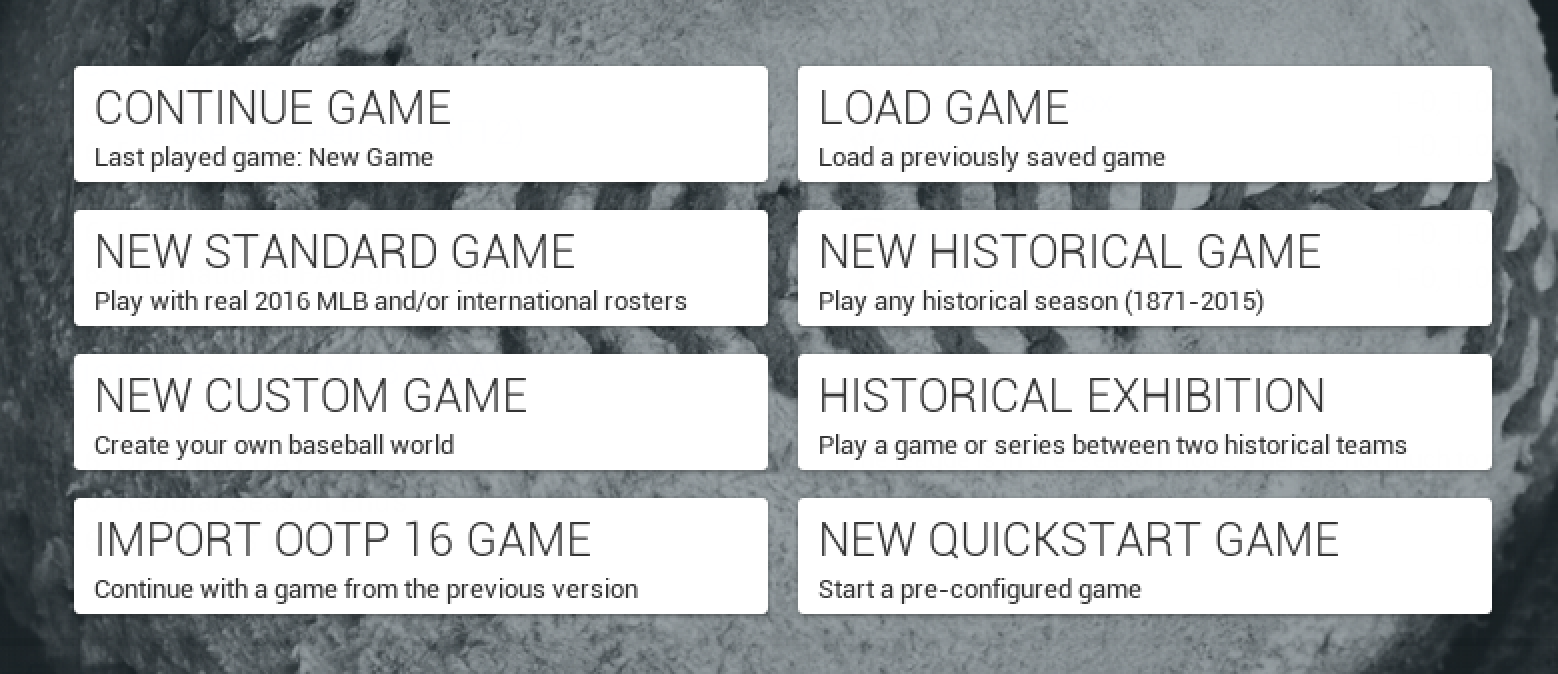
When you start OOTP 17, a well rated baseball simulation app, these are the main choices available on the first screen you see. Stumbling through the online manual on my first day of exploration, I found the choice that would enable me to begin playing with the current MLB teams: “New Standard Game.” 

Menu on OOTP Home Screen

What I did not know at the time was that in “New Standard Game” OOTP defines game differently than I do, something I did not discover until later. I expected its “game” to mean a typical baseball game, the type I watch on TV. But that’s not how OOTP defines it. It defines it in a broader sense, more like the “game of baseball,” but even then the game played in the Major Leagues differs from the Little League game, and both of them are not identical to the game played in the Gulf Coast League.

In its online documentation’s section titled “Game Universe Terminology,” the closest definition I found was of a “saved game,” which is

one ‘universe’ of baseball in OOTP. A saved game could contain one league, five leagues, one league with multiple ‘subleagues,’ or any other combination of leagues and subleagues.

A “universe” of baseball is such a broad term I’m not going to try to define it; instead I re-viewed “New Standard Game” as meaning “New Game Universe.” And since then, I’ve slowly been learning what that universe includes — and how to play an MLB game the OOTP way.

Three More Mets Minor League First Basemen

Previously, I looked at first basemen in the Mets three lowest Minor League teams. Today, I’ll look at first basemen playing for the Savannah Sand Gnats, St. Lucie Mets, and Binghamton Mets.

At Savannah, 24-year-old Sam Honeck’s been the primary first baseman. Currently, he’s on the 7-day DL. In his third season of pro ball, he’s hitting only .227 with a slugging average of .346, not the numbers you’d like to see from a first baseman. The Mets selected Honeck in the 11th round of the 2009 MLB Draft.

At St. Lucie, Stefan Welch plays first base. He’s been in the Mets organization since 2007, signed out of Australia. This season he’s hitting .267 with a .433 slugging average. Of his 29 extra base hits, 10 are homers. In the 10-game span from July 11-21, the 22-year-old hit .429 with a slugging average of .543.

Manning first base for the Binghamton Mets is 24-year-old Allan Dykstra, one of the season’s most pleasant surprises. Traded for Eddie Kunz, the Padres 2008 first-round draft choice is hitting .270 with 13 homers and 51 RBIs. He’s been particularly effective batting with runners on base, hitting .300 in those situations.

The three first basemen discussed in today’s post coupled with the three discussed in a previous post indicate that the Mets are well-positioned at first base from their Rookie League teams through Double-A.

A Look at Three First Basemen Drafted in 2011

The Mets drafted three first basemen in 2011: Ryan Hutson (Rd 36), Tant Shepherd (Rd 24), and Cole Frenzel (Rd 7). All three are currently playing for Mets farm teams.

In his last 10 games with the GCL Mets beginning with the July 7 game, Ryan Huston has been swinging the bat much batter. In that span he’s hit .310 with nine hits in 29 at bats. Five of those were extra base hits, which gave him a slugging average during that period of .552. As a result, he’s upped his average by 45 points. Before July 7, it was .205; now, it’s .250. His OPS is .778.

Surprisingly, the right-handed batter is hitting righties much better than lefties. Against righties he’s hitting .269; against lefties, .188.

Tant Shepherd, who played first base for the University of Texas, has been switched to third base by the Kingsport Mets. The move has not helped his bat. He’s currently hitting only .167 in 42 at bats with only two extra base hits, both doubles, and one RBI. In contrast, in his final season at Texas, he hit .303. The Mets might want to consider returning him to first base. His OPS is .514.

In Brooklyn, Cole Frenzel is manning first base. Frenzel is hitting .297. In 37 at bats, he has seven RBIs but only two extra base hits, a double and a triple. The left-handed batter is hitting well against both righties (.294) and lefties (.333). His OPS is .765.

Though Shepherd is not currently playing first base and is in a batting slump, those three draftees seem to have improved substantially the Mets farm system’s future at first base.