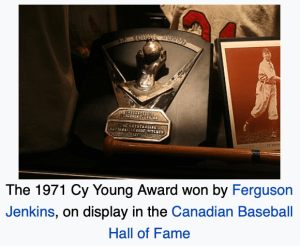
Cy Young Lives On

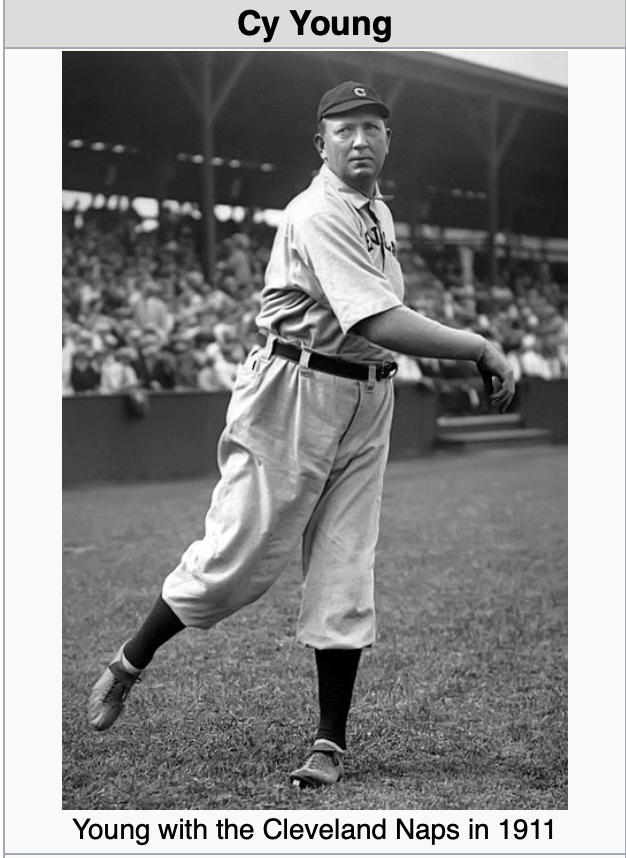
For more than 60 years, baseball has recognized its mound stars with a plaque that memorializes the achievements of a man whose 22-year career began in 1890.

When he retired at age 45, Denton True “Cy” Young had won 511 games and, until his next-to-last year in 1910, never lost more games in a season than he won.

Young’s greatest achievement may have come on May 5, 1904, when at the age of 37 he pitched the first perfect game in American League history – just the third in the major leagues and the first from the 60-foot-6-inch pitching distance. 

https://sabr.org/bioproj/person/dae2fb8a

Young died in 1955. A year later Major League Baseball awarded the first Cy Young Award, to Don Newcombe, who got 10 of the 16 first-place votes.

Since Newcombe, 117 more pitchers have won the prize.

During those first 11 years, just one pitcher won it more than once. Sandy Koufax won it three times. While others won it three times, only Roger Clemens (7), Randy Johnson (5), Greg Maddox (4), and Steve Carlton (4) won it more than three times.

Koufax was also one of five winners who pitched for the Los Angeles Dodgers, the Dodgers winning the prize five years in a row.

Further, five of the first 11 winners made it to the Hall of Fame: Warren Spahn, Early Wynn, Whitey Ford, Don Drysdale, and Sandy Koufax.

In 1966, Koufax was the last sole winner in a season. After his final receipt of the award, it was given to the best pitcher in each league.

Cy Young won 477 complete games, fully 60 more than Walter Johnson. Only five times did he win a game that he had started but not completed.

https://sabr.org/bioproj/person/dae2fb8a

At first, those winning it were starters who had won at least 20 games. That ended in 1973 when members of the Baseball Writers’ Association of America awarded it to Tom Seaver though he had a 19-10 record.

A year later, the first reliever won the Cy Young. Mike Marshall, pitching for the Los Angeles Dodgers, finished the 1974 season with a 15-12 record. He stood on the mound in 106 games, 30 more than Rollie Fingers, and pitched in 208.1 innings, starter’s numbers. So he averaged just under two innings a game. Despite all those appearances, his ERA was just 2.42.

Though Marshall had 21 saves, he did not lead the lead in that category, coming in second to Terry Forster who had 24 in 59 games. Despite being the runner-up in saves, Marshall was named the The Sporting News’ Fireman of the Year. 

After Marshall, eight other relievers have won the Cy Young, but none since another Dodger, Eric Gagne, received it in 2003.

Among all pitchers, both starters and relievers, only 11 have won the award in back-to-back seasons. Among them is Jacob deGrom, Mets standout, who received it in both 2018 and 2019, winning 21 games. However, unlike Gaylord Perry, those wins were not in one season but two, 10 in 2018 and 11 in 2019. Those two win totals were the lowest ever for a Cy Young Award winner who was a starter.

Cy Young threw a baseball until his right arm could no longer obey his mind’s commands.

“All us Youngs could throw,” he said. “I used to kill squirrels with a stone when I was a kid, and my granddad once killed a turkey buzzard on the fly with a rock.”

https://www.baseball-almanac.com/quotes/quoyung.shtml

He was inducted into baseball’s Hall of Fame in 1937.

On his tombstone, above his name and that of his wife, is a winged baseball.

Dodgers hammer Diaz despite his “excellent pitches”

During yesterday’s ninth inning loss, the Mets’ closer, Edwin Diaz, pitched batting practice for the Dodgers. As a result, his ERA in away games jumped to 4.50. At home, it is 2.19.

When he entered the game in the bottom of the ninth, the Dodgers had a 3.4% chance of winning, according to FanGraphs. Then, seven batters and one out later, the Dodgers won the game 9-8.

The graphic below shows how the game’s Win Expectancy shifted in the bottom of the ninth.

Source: FanGraphs

Five of the seven batters that Diaz faced had batted balls: two homers, two doubles, an intentional walk, a single, and a sacrifice fly. The chart below shows the pitch location of five of the six batted balls. (Justin Turner’s double is shown. Cody Bellinger’s is not.)

Source: Baseball Savant

Here are Diaz’s pitches the Dodgers hit (data from Baseball Savant):
– Home run: Slider (Pederson)
– Home run: Four-seam fastball (Muncy)
– Double: Slider (Turner)
– Double: Four-seam fastball (Bellinger)
– Single: Two-seam fastball (Beaty)
– Sacrifice fly: Slider

Diaz threw 30 pitches, but only four- and two-seam fastballs and sliders. Three of the nine sliders were batted balls, but only three of the 21 fastballs were. Further, while 11 fastballs were fouled off only one slider was. But the average exit velocity of the fastballs was 100.1 mph, four mph faster than for the sliders.

Only 43.3% of the pitchers were in the zone; however, the Dodgers swung at 84.6% of them, showing excellent plate discipline: They made contact with 81.8 % of them.

Source: Baseball Savant

The next chart, a spray chart shows how spread out the Dodgers’ batted balls were.

Source: Baseball Savant

After the game, Diaz said,

“Today was easily the worst day of my career, the worst game of my career, the worst game of the season for me,” Diaz said through an interpreter. “I thought I threw excellent pitches.”

Anthony DiComo — Edwin Diaz blows save against Dodgers | New York Mets

What makes yesterday’s outing particularly surprising is that, after it, left-handed hitters are batting .188/.250/.531 against Diaz; whereas, right-handed batters are hitting .286/.344/.429. Six of the seven Dodger batters that Diaz faced were left-handed.

As, if not more, surprising is that in away games, batters are now hitting .310 against him versus only .196 in home games.

Yesterday, while Diaz was on the mound, Wilson Ramos was behind the plate.

Statcast Primer: Finding Hits on 2-Strike Count — 2018

In 2018, what Mets pitcher gave up the most hits when the batter faced a two-strike count (0-2, 1-2, 2-2, 3-2)?

Statcast Search Settings

  • PA Result: Home Run (4) — single, double, triple, home run
  • Season Type: Regular Season
  • Count: 2 Strikes
  • Season: 2018
  • Player Type: Pitcher
  • Team: Mets
  • Min # of Total Pitches: 100 Pitches
  • Sort By: Pitches
  • Change Total Pitch Parameters (2): Count and Plate Appearances

Results

Steven Matz gave up the most hits on a two-strike count, 70, while tying for second in the percentage of hits given up (per plate appearances) on a two-strike count, 17.8%.

Among the starters, Jacob deGrom had the lowest percentage of hits given up (per plate appearances) on a two-strike count, 10.5%. That was also the lowest percentage in Major League Baseball among pitchers who faced at least 400 batters. Only two other pitchers had a percentage under 11%. Blake Snell was at 10.8% and Gerrit Cole was at 10.8%. The League average was 15.7%.


Finding Met with most base hits in 2019 with runners on base

Which Mets player had the most base hits in 2019 with runners on base?

That is the research question which the table at the top of this page answers.

How to get the information in the table
(I did the search before the Mets game on May 2, 2019. As you will be doing it on a later date, your results will be different.)

Go to Statcast Search and match the settings below.

For PA (Plate Appearance) Result you have 26 choices. Group select “Base Hit” to choose all four types of hits: single, double, triple, and home run. This will appear in the PA Result box as “Homerun (4).”

For Season Type you have three choices: Regular Season, Playoffs, and Spring Training. Choose “Regular Season.”

Season: 2019

Player Type: From the 10 choices, select “Batter.”

Team: Select “Mets.”

Runners On: You have nine choices. Select “Runner On Base.”

Min # of Total Pitches: Choose 50. That will require a player to have at least 50 plate appearances (not pitches) because of the next setting. Though the row heading say “Total Pitches,” I will be overriding that so it contains plate appearances.

Change Total Pitch Parameters: “Check Plate Appearances.”

Note: On its bottom, The Change Total Pitch Parameters box contains these statements: (a) “Use these check boxes to select which columns to include in the ‘Total Pitches’ column in the results” and (b) “The default is every pitch.” By checking “Plate Appearances” that information will appear under the heading “Total Pitches” in the resulting table.

In addition, check “Runner On.” Then, the search result will show all the 2019 plate appearances of the Mets hitters in which there was at least one runner on base and, in them, how many base hits there were.

Change Total Pitch Parameters box, Source: Baseball Savant

It would be preferable if “Plate Appearances” appeared instead of “Total Pitches,” but that is not what happens. To further confuse things, there is a Results column in the Results table. The Results column in this scenario contains the number of base hits. Finally, the “% of Pitches” column does not contain a pitch count. Instead, it contains the percent of plate appearances in which the player got a base hit.

Analysis of Results
Amed Rosario has the most base hits so far in 2019 with runners on base. He came to the plate 58 times with runners on base and got a base hit in 19 of them (32.8%).

In the results table below, for clarity the column headings have been adjusted.

This link will take you the Statcast Search page that shows the Search form.

In contrast, Rosario had 58 plate appearances with no one on base and got 11 hits in them (19.0% of those plate appearances) — That data is from a different Statcast search.

Rosario had a much higher hit rate with runners on base than with none on (32.8% vs. 19.0%). Did the added pressure of “runners on” cause him to concentrate more? Did he change his hitting approach?

The next statistics are from baseball-reference.com. They were obtained on May 2, 2019 for Amed Rosario to provide independent verification of his Statcast results:

The first row in the table from Baseball Reference contains data that we have not obtained. To get Rosario’s RISP results in Statcast, two changes must be made. One is the “Runners On” row’s contents must be switched to “RISP,” but if that were the only change made, when I ran the search I would get this message: “There are no results for your search.” That’s because no Mets batter has 50 plate appearances with a runner in scoring position — it’s too early in the season. By reducing “Min # of Total Pitches” to 25 I averted the problem.

For those interested, Rosario got those 11 hits in 32.4% of his plate appearances with a runner in scoring position (34). That was the highest percentage on the team. Ramos was second, and though he also had 11 hits with RISP, he got them in 38 plate appearances (28.9%). Surprisingly, Alonso was fourth with only six hits in 26 PA (23.1%). Third best was McNeil with 10 hits in 35 PA (28.6%). Rounding out the top six was J.D. Davis with 5 hits in 29 PA (17.2%) and Conforto with 5 hits in 39 PA (12.8%).