Statcast Primer: Finding Hits on 2-Strike Count — 2018

In 2018, what Mets pitcher gave up the most hits when the batter faced a two-strike count (0-2, 1-2, 2-2, 3-2)?

Statcast Search Settings

  • PA Result: Home Run (4) — single, double, triple, home run
  • Season Type: Regular Season
  • Count: 2 Strikes
  • Season: 2018
  • Player Type: Pitcher
  • Team: Mets
  • Min # of Total Pitches: 100 Pitches
  • Sort By: Pitches
  • Change Total Pitch Parameters (2): Count and Plate Appearances

Results

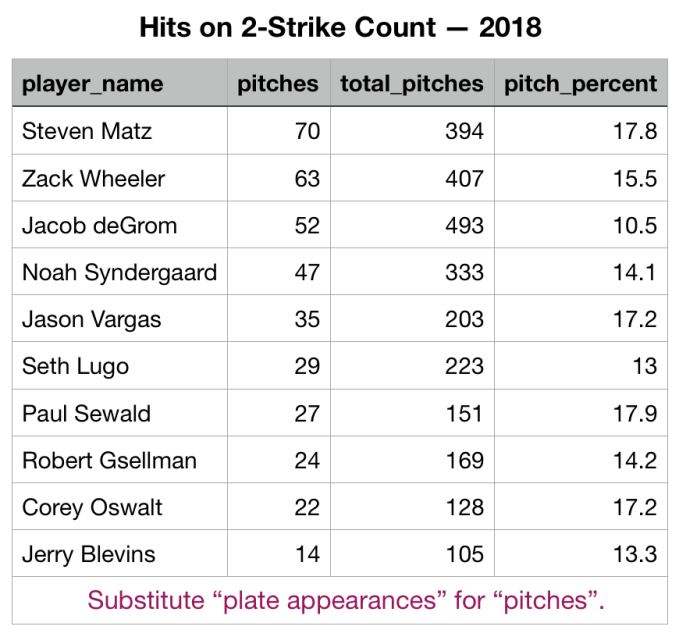
Steven Matz gave up the most hits on a two-strike count, 70, while tying for second in the percentage of hits given up (per plate appearances) on a two-strike count, 17.8%.

Among the starters, Jacob deGrom had the lowest percentage of hits given up (per plate appearances) on a two-strike count, 10.5%. That was also the lowest percentage in Major League Baseball among pitchers who faced at least 400 batters. Only two other pitchers had a percentage under 11%. Blake Snell was at 10.8% and Gerrit Cole was at 10.8%. The League average was 15.7%.


Finding Met with most base hits in 2019 with runners on base

Which Mets player had the most base hits in 2019 with runners on base?

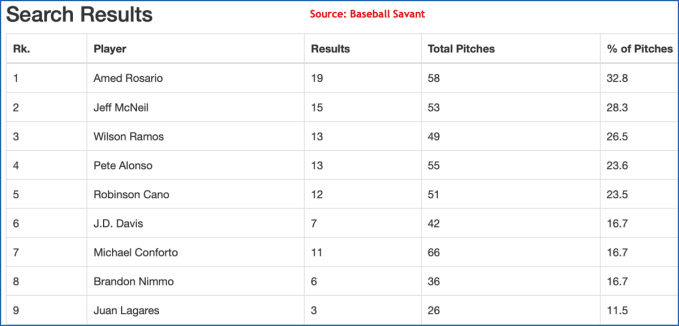
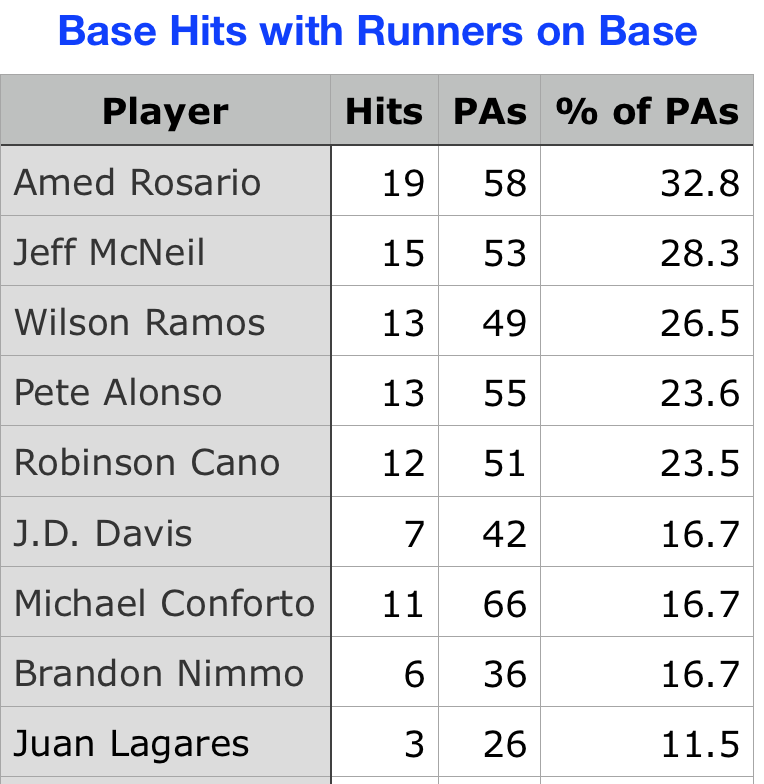
That is the research question which the table at the top of this page answers.

How to get the information in the table
(I did the search before the Mets game on May 2, 2019. As you will be doing it on a later date, your results will be different.)

Go to Statcast Search and match the settings below.

For PA (Plate Appearance) Result you have 26 choices. Group select “Base Hit” to choose all four types of hits: single, double, triple, and home run. This will appear in the PA Result box as “Homerun (4).”

For Season Type you have three choices: Regular Season, Playoffs, and Spring Training. Choose “Regular Season.”

Season: 2019

Player Type: From the 10 choices, select “Batter.”

Team: Select “Mets.”

Runners On: You have nine choices. Select “Runner On Base.”

Min # of Total Pitches: Choose 50. That will require a player to have at least 50 plate appearances (not pitches) because of the next setting. Though the row heading say “Total Pitches,” I will be overriding that so it contains plate appearances.

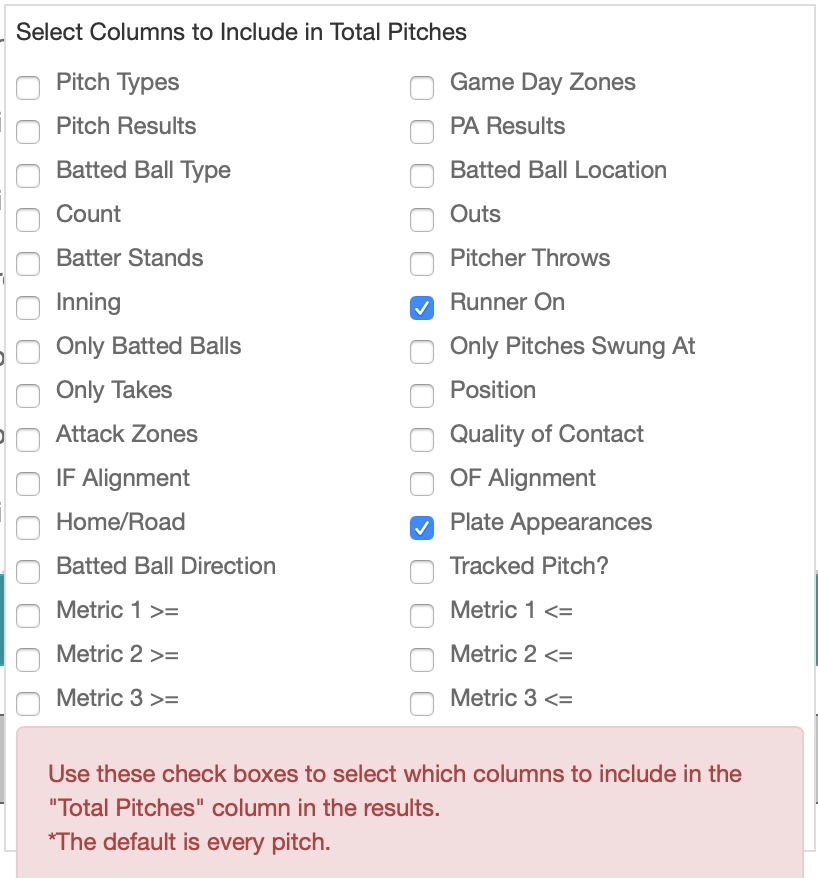
Change Total Pitch Parameters: “Check Plate Appearances.”

Note: On its bottom, The Change Total Pitch Parameters box contains these statements: (a) “Use these check boxes to select which columns to include in the ‘Total Pitches’ column in the results” and (b) “The default is every pitch.” By checking “Plate Appearances” that information will appear under the heading “Total Pitches” in the resulting table.

In addition, check “Runner On.” Then, the search result will show all the 2019 plate appearances of the Mets hitters in which there was at least one runner on base and, in them, how many base hits there were.

Change Total Pitch Parameters box, Source: Baseball Savant

It would be preferable if “Plate Appearances” appeared instead of “Total Pitches,” but that is not what happens. To further confuse things, there is a Results column in the Results table. The Results column in this scenario contains the number of base hits. Finally, the “% of Pitches” column does not contain a pitch count. Instead, it contains the percent of plate appearances in which the player got a base hit.

Analysis of Results
Amed Rosario has the most base hits so far in 2019 with runners on base. He came to the plate 58 times with runners on base and got a base hit in 19 of them (32.8%).

In the results table below, for clarity the column headings have been adjusted.

This link will take you the Statcast Search page that shows the Search form.

In contrast, Rosario had 58 plate appearances with no one on base and got 11 hits in them (19.0% of those plate appearances) — That data is from a different Statcast search.

Rosario had a much higher hit rate with runners on base than with none on (32.8% vs. 19.0%). Did the added pressure of “runners on” cause him to concentrate more? Did he change his hitting approach?

The next statistics are from baseball-reference.com. They were obtained on May 2, 2019 for Amed Rosario to provide independent verification of his Statcast results:

The first row in the table from Baseball Reference contains data that we have not obtained. To get Rosario’s RISP results in Statcast, two changes must be made. One is the “Runners On” row’s contents must be switched to “RISP,” but if that were the only change made, when I ran the search I would get this message: “There are no results for your search.” That’s because no Mets batter has 50 plate appearances with a runner in scoring position — it’s too early in the season. By reducing “Min # of Total Pitches” to 25 I averted the problem.

For those interested, Rosario got those 11 hits in 32.4% of his plate appearances with a runner in scoring position (34). That was the highest percentage on the team. Ramos was second, and though he also had 11 hits with RISP, he got them in 38 plate appearances (28.9%). Surprisingly, Alonso was fourth with only six hits in 26 PA (23.1%). Third best was McNeil with 10 hits in 35 PA (28.6%). Rounding out the top six was J.D. Davis with 5 hits in 29 PA (17.2%) and Conforto with 5 hits in 39 PA (12.8%).

Ramos needs to narrow extra-base hits gap between him and Alonso

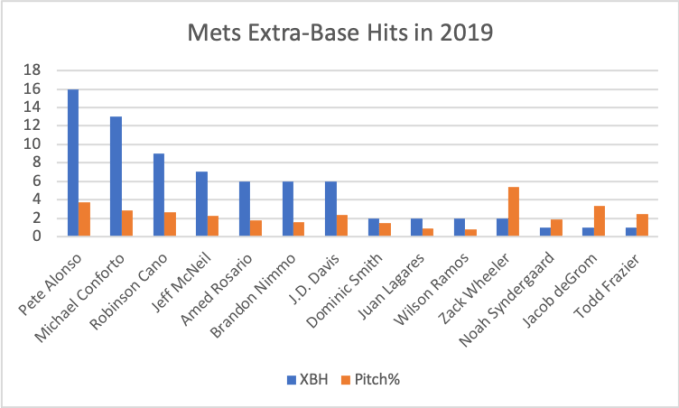
After 24 games, Pete Alonso leads the Mets with 16 extra-base hits.

He’s also sixth in Major League Baseball with 58 total bases. Further, his .682 slugging percentage is the highest on the team and the 13th-best in Major League Baseball.

At the opposite extreme is Wilson Ramos with an 24 total bases and an SLG of .333, the 25th-lowest one out of 186 players. So far this season, he has only two extra-base hits, a double and a homer.

A Mets pitcher, Zach Wheeler, has as many extra-base hits.

Continue reading “Ramos needs to narrow extra-base hits gap between him and Alonso”

Part 1: My First Day Exploring OOTP 17

OOTP 17 is a baseball app that enables you to do much more than play baseball on a computer, where OOTP stands for Out of the Park. How much more I did not realize until began playing with the app on my Mac. And though I’d played many times both the APBA and the Strat-O-Matic baseball board games and APBA’s computer baseball game, I was not prepared for what I encountered after installing OOTP 17.

Read my APBA interview.

When you start OOTP 17, a well rated baseball simulation app, these are the main choices available on the first screen you see. Stumbling through the online manual on my first day of exploration, I found the choice that would enable me to begin playing with the current MLB teams: “New Standard Game.” 

Menu on OOTP Home Screen

What I did not know at the time was that in “New Standard Game” OOTP defines game differently than I do, something I did not discover until later. I expected its “game” to mean a typical baseball game, the type I watch on TV. But that’s not how OOTP defines it. It defines it in a broader sense, more like the “game of baseball,” but even then the game played in the Major Leagues differs from the Little League game, and both of them are not identical to the game played in the Gulf Coast League.

In its online documentation’s section titled “Game Universe Terminology,” the closest definition I found was of a “saved game,” which is

one ‘universe’ of baseball in OOTP. A saved game could contain one league, five leagues, one league with multiple ‘subleagues,’ or any other combination of leagues and subleagues.

A “universe” of baseball is such a broad term I’m not going to try to define it; instead I re-viewed “New Standard Game” as meaning “New Game Universe.” And since then, I’ve slowly been learning what that universe includes — and how to play an MLB game the OOTP way.