Mets Pitching Will Be Tested Against Top-Hitting Cardinals

After dropping two of three to the Twins—despite both teams scoring 11 runs in the series—the Mets now face the Cardinals. That near sweep got me wondering: how have the Mets fared against St. Louis lately?

Since 2020, the Mets are 15–12 against the Cardinals, including just 5–8 at home. And the last time the Mets swept the Cardinals at home was all the way back in 1988. It’s the only time it’s ever happened. That was before Citi Field, before Mike Piazza, and before most of today’s roster was even born.

That 1988 Mets team won 100 games. Darryl Strawberry led the league with 39 home runs, and Dwight Gooden went 18–9 with a 3.19 ERA. It’s been a while.

This season, the Cardinals are sitting at 9–9, right in the middle of the NL Central, while the Mets lead the NL East at 11–7. But here’s the twist: the Cardinals lead the majors with a team batting average of .280. The Mets? They rank 22nd at .219—a 61-point gap.

So how are the Mets winning? Pitching. Until the Twins series, their staff had been in lockdown mode, keeping runs off the board and covering for an offense that acted like it had to pay a silent penalty every time it reached base.

Seven Mets batters are barely treading water at the plate. Four haven’t even cracked .200—and one is barely visible:

  • José Siti: .050 (That’s not a typo.)
  • Mark Vientos: .145
  • Tyrone Taylor: .163
  • Starling Marte: .167
  • Brett Baty: .175
  • Jesse Winker: .200
  • Brandon Nimmo: .203

If I hit like that in Little League, I never would’ve made it off the bench.

And while batting average isn’t the most fashionable stat these days—on-base percentage is the current darling—it’s still hard for me, as an old-school fan, to ignore how poor these numbers are.

Where does that leave us for tonight’s game? Griffin Canning is starting for the Queens men. He faced the Cardinals once last season, throwing six innings for San Diego and notching the win. Before that, in two other starts—one in 2023 and one in 2019—he split the results, with one win and one loss. Given his win against the Cardinals last year as a Padre and the Mets’ adjustments to his pitching, I’m hoping Canning can keep them from outscoring the Mets tonight during his time on the mound.
Blazing fastballs, monster swings, and one sleepy dribbler: Some 2025 Mets highlights

💥 On the Mound

⚾️ 🔥 Ryne Stanek lights up the radar gun at 100.1 mph with a four-seam fastball on April 8. He was flaming that day—three more pitches touched 99.

⤵️ ⚾️ Kodai Senga floats in a 68.5 mph curveball on April 1. Sixteen of his pitches caused swings and misses—but not that slow breaker. It drifted outside for a ball.

💥 At the Plate

⚾️🔥 Pete Alonso drives one to right at 114.5 mph. He pulls up at second, lucky not to get a speeding ticket for the ball’s exit velocity. His bat was electric that day—he launched a 113.4 mph homer, ripped another double at 113.1, and even clobbered a lineout that jumped off the bat at 107.1.

⬇️ ⚾️ Francisco Lindor gets jammed and taps one at just 31.9 mph—an ultrasoft grounder—back to the pitcher. The throw to first beats him before his engine can even get up any steam.

⤴️⚾⤵️ Baseball’s a game of contrast with its missiles to dribblers and whiffs to weak contact, the only sport that swings so wide.

Data from Baseball Savant.

Mets Best Starters by Decade

To win a baseball game, a team needs to outscore its opponents. To do that, it needs to prevent the other team from scoring as many runs as it does. The leader of the prevention part is the pitcher.

No batter leads the offense the same way that a pitcher leads the defense. He — and the catcher — are involved in the most plays in a game, but the pitcher plays a bigger role because what he does initiates the majority of a game’s plays.

A measure of a pitcher’s success in limiting other teams’ run scoring is the RE24 stat. An RE24 of zero means the player is average. On some websites, the higher a pitcher’s RE24, AKA run value, the better the pitcher performed, so a value of +24 would be much better than -24.

Sites that express it that way are Baseball Reference, FanGraphs, and Stathead with Baseball Reference now calling the RE24 for pitchers “Base-Out Runs Saved“; whereas, on other sites, such as Baseball Savant, it is the opposite: the lower a pitcher’s run value, the better. A value of -24 would be much better than +24.

Further, the complexity of the RE24 calculation has increased substantially since its early days when it was based on just base/out states and outs. For example, today on Baseball Savant, there is a Pitch Arsenal Stats Leaderboard giving a pitcher’s run value based on pitch type (e.g., changeup) “and on the runners on base, out, [and] ball and strike count,” and a Swing & Take Leaderboard giving for a pitcher a run value based on a pitch’s “outcome (ball, strike, home run, etc).”

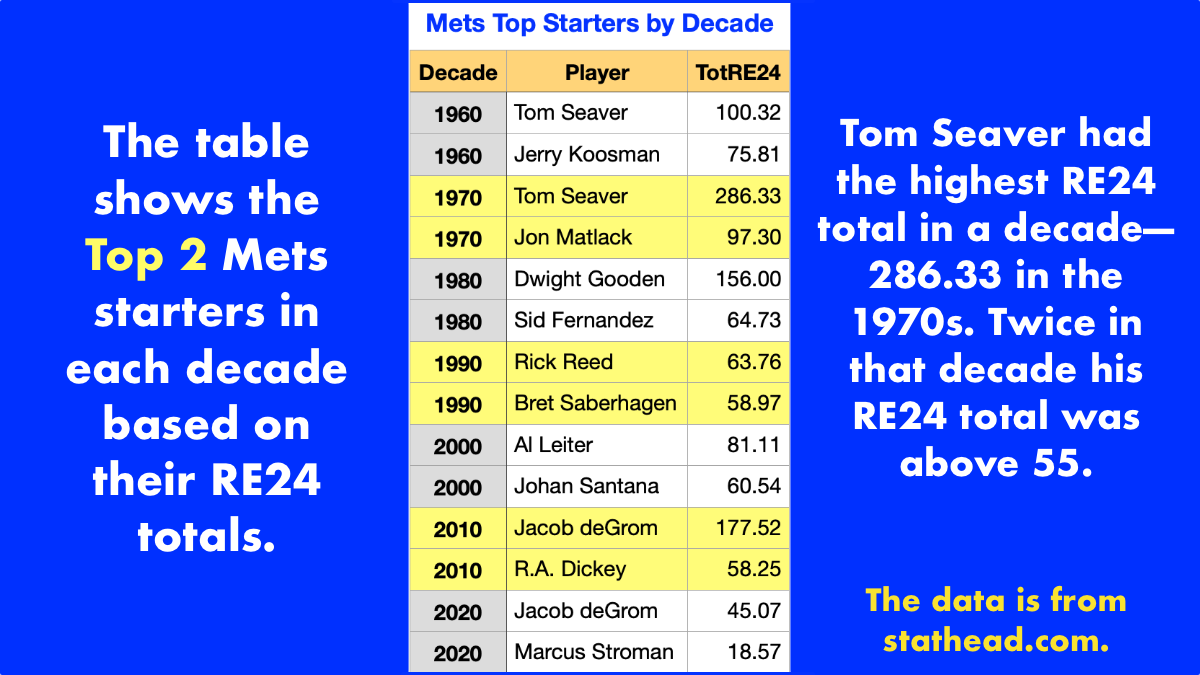
In the chart below, the Mets top two starters in each decade based upon their RE24 totals (base-out state) in that decade are shown. The decade leaders are Tom Seaver (twice), Dwight Gooden, Rick Reed, Al Leiter, and (so far in this decade) Jacob deGrom (twice). Those five would make a starting rotation that few Mets fans would complain about.

The second-place finishers include Jerry Koosman, Jon Matlack, Sid Fernandez, Bret Saberhagen, Johan Santana, R. A. Dickey, and Marcus Stroman. Further, Matlack had a higher RE24 than did the first-place finisher in two other full decades: the 1990s and 2000s. Even the second-place finishers would make a strong starting rotation.

One pitcher yet to throw a pitch for the Mets, but who is now a member of the team, Max Scherzer, has in his 14 years in Major League Baseball accumulated an RE24 of 318.5. In that timespan, only two other pitchers have accumulated a higher RE24: Justin Verlander is at 327.22, and Clayton Kershaw is at 431.64.

And in the decade from 2010 to 2019, Scherzer remains in third place with Jacob deGrom in eighth and Carlos Carrasco 33rd.