The New Knuckleball

This season, not one knuckleball has been thrown.

In 2018, only one pitcher threw it — Steven Wright. His nickname is “Knucksie.” He threw 824 pitches. Of them, 719 or 87.3% were knuckleballs. This season, he has yet to play because of an 80-game suspension.

In 2017, three pitchers threw them: R. A. Dickey, Steven Wright, and Erick Aybar, with Dickey throwing the most — 2,333.

In an article on NPR’s website, physicist Alan Nathan describes how a knuckleball is thrown.

The ball has to be gripped with two (carefully manicured) fingernails and sort of pushed toward the plate. The object is to put just a little spin on it and let it be nudged around as air flows over the ball’s stitches and any little scrapes or abrasions on the leather.

The article also contains an image of “the knuckleball grip used by Boston Red Sox pitcher Steven Wright.”

Hoyt Wilhelm 1959 (Wikimedia)

Though the knuckleball has brought renown to Hall of Famer Hoyt Wilhelm and others, it’s almost extinct today in the major leagues, replaced by the knuckle curve, an offshoot of the knuckleball. Wilhelm threw his first pitch in Major League Baseball on April 18, 1952 when he was 28 years old, his career lasting until July 21, 1972.

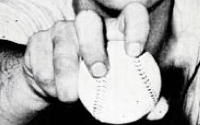
Dan Rozenson, in a Baseball Prospectus article, describes how a knuckle curve is gripped and includes this image.

In a Sports Illustrated article, Gerrit Cole’s knuckle curveball is described as “filthy.” Watch it in action:

This season, as of May 15, 51 pitchers have thrown at least one knuckle curve though eight have thrown just one. Among the pitchers who throw it are Zach Godley, Aaron Nola, and Drew Pomeranz. In 2019, all three have already thrown more than 200 with Godley throwing the most: 48.2% of all the pitches that he has thrown have been knuckle curves, which is the most in MLB: Statcast Search | baseballsavant.com. Of his 341 knuckle curves — out of 708 pitches, batters got 18 hits (5.3%), the lowest percent of the top three, Statcast Search | baseballsavant.com. With his other 367 pitches, batters got 26 hits (7.1%), so he has been somewhat more effective when throwing the knuckle curve.

Last season’s knuckle curve leader, Lance McCullers Jr. (982, 46.6%), has yet to play in 2019 because of Tommy John surgery.

Though to some it seems like a hard pitch to hit, in 2019 batters are hitting .234 (191 for 817) off knuckle curves — Statcast Search | baseballsavant.com — but only .213 (2474 for 11603) against the other breaking pitches (slider, curveball, knuckleball, Eephus) and .217 (1221 for 5616) against off-speed pitches. On the plus side, the league average against fastballs is .266 (6266 for 23533).

Godley’s focus on the knuckle curve has not seemed to benefit him. His 2019 ERA is 7.65 (highest in his career) in 37.2 innings though his fielders must assume some responsibility as his FIP is 5.66, almost two points fewer, and his Contact Percentage is 75.3%, the highest in his career, according to FanGraphs.

Three teams have thrown only one knuckle curve this season: Pirates, Rays, and Braves. Together, they have thrown 18,302 pitches. The Diamondbacks have thrown the most knuckle curves: 526.
Statcast School: Barrels

Pete Alonso has quickly become one of the top power hitters in Major League Baseball, but unlike in days of old, how many homers a batter hits and how far he hits them are no longer the only measures of a slugger. Today, “barrels” has become a popular indicator.

In an article for Baseball Prospectus, Russell A. Carleton wrote that

Until Statcast, we didn’t have systematic (public) data on how hard a batter hit the ball. Now, we know how fast the ball was going when it left the bat and at what angle the ball was “launched.”

MLB defines a barrel as those

batted-ball events whose comparable hit types (in terms of exit velocity and launch angle) have led to a minimum .500 batting average and 1.500 slugging percentage since Statcast was implemented Major League wide in 2015.

Further, “To be Barreled, a batted ball requires an exit velocity of at least 98 mph,” according to MLB.

Here is MLB’s definition of a batted-ball event:

A Batted Ball Event represents any batted ball that produces a result. This includes outs, hits and errors. Any fair ball is a Batted Ball Event. So, too, are foul balls that result in an out or an error.

To start, in Statcast I sought to answer this question: Which players have hit the most barrels this season. To do the search, I used the search settings below.

Player Type: Batter
Season: 2019
Season Type: Regular Season
Quality of Contact: Barrel
Min # of Total Pitches: 25 Pitches
Sort By: Pitches
Change Total Pitch Parameters: Click “Plate Appearances.”

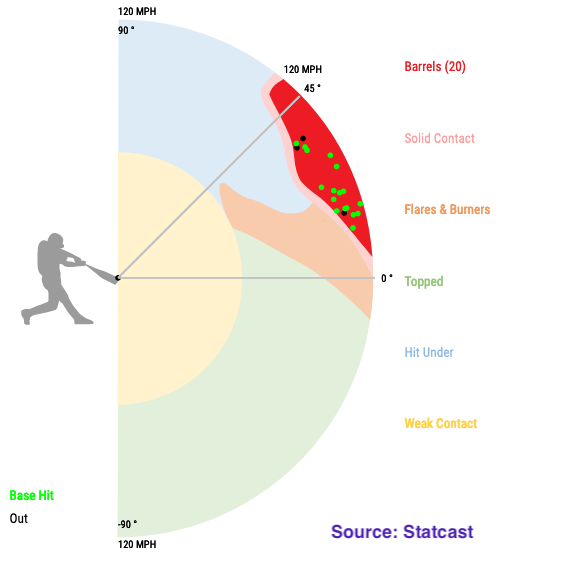
Being a Mets fan, the third name in the results drew my attention: Pete Alonso. Up to May 13 he has 20 barrels in 165 plate appearances (12.1%). The radial chart below shows the exit velocity and launch angle of each barrel. The area in red contains the barrels. To see the “live” chart, click this link.

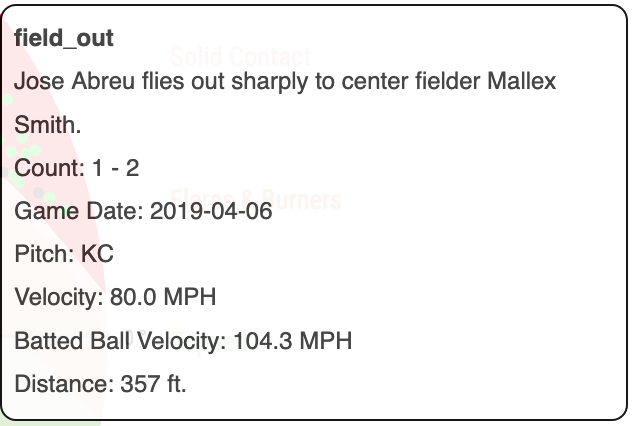
Position your cursor over the topmost circle in the Barrels area. When you do that, the information in the image below should appear.

The three black circles indicate outs, the 17 green circles hits, so not every barreled ball is a hit. “KC” is knuckle curve.

Some other facts:

  • The average distance of Alonso’s barreled balls is 386.5 feet.
  • The average launch angle is 23.69º.
  • The average exit velocity is 109.8 mph.
  • The hardest-hit ball traveled at 118.3 mph.
  • The lowest launch angle was 12º: the result, a line drive double to left field.

Statcast Primer: Whiffs in Chase Zone

How many pitches in 2019 have Mets hitters swung at and missed that were in the Chase zone?

Statcast Search Settings
  • Pitch Result: Under “Group Select” click “Swing & Miss.” Four items will be selected: Foul Tip, Swinging Pitchout, Swinging Strike, Swinging Strike (Blocked).
  • Player Type: Batter
  • Team: Mets
  • Attack Zones: Under “Group Select” click “Chase.” Eight items will be selected (21-24, 26-29).
  • Season: 2019
  • Season Type: Regular Season
  • Min # of Total Pitches: 25 Pitches
  • Sort By: Pitches
  • Change Total Pitch Parameters: Click “Attack Zones.”
Search Results

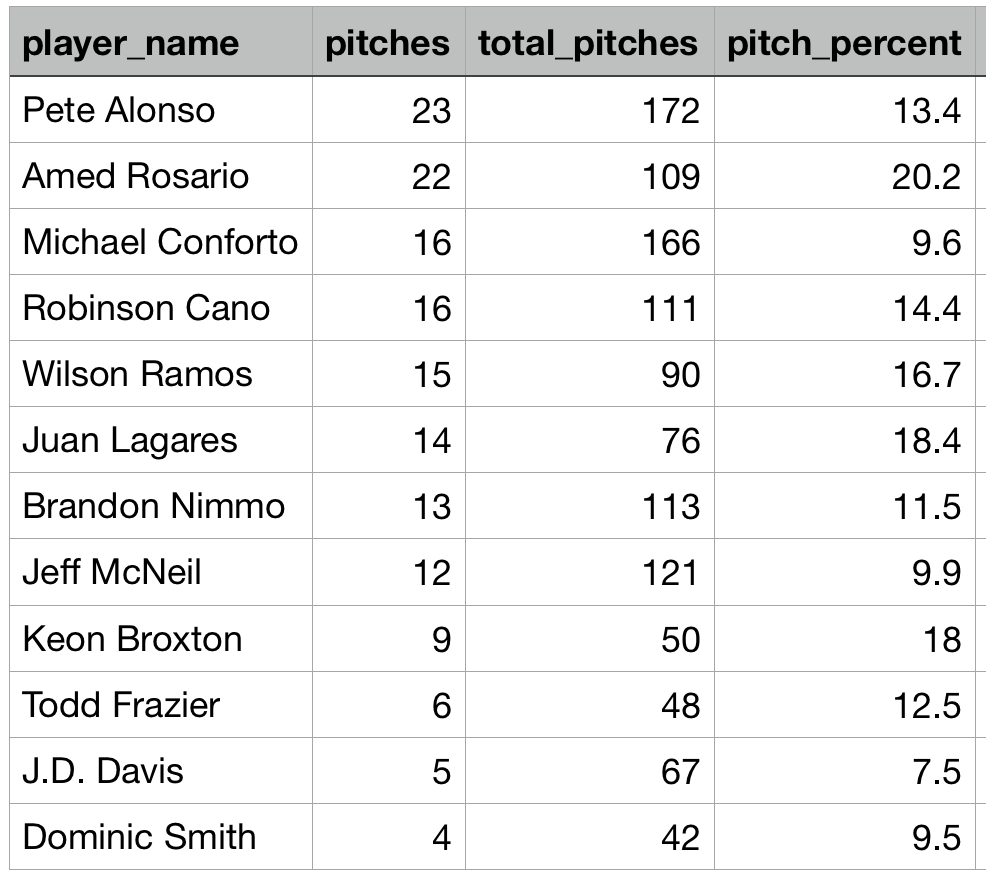
Here are the qualifiers as of May 6, 2019 sorted by Pitches (results)

Mets Whiffs in Chase Zone — 2019 — ordered by number of whiffs
Analysis of Results

Pete Alonso whiffed on the most pitches (23) in the Chase zone, but Amed Rosario, who swung at and missed 22, had the highest percentage of whiffs — 20.2%. The lowest percentage belonged to J. D. Davis (5), but he also had the fourth-fewest qualifying plate appearances (67).

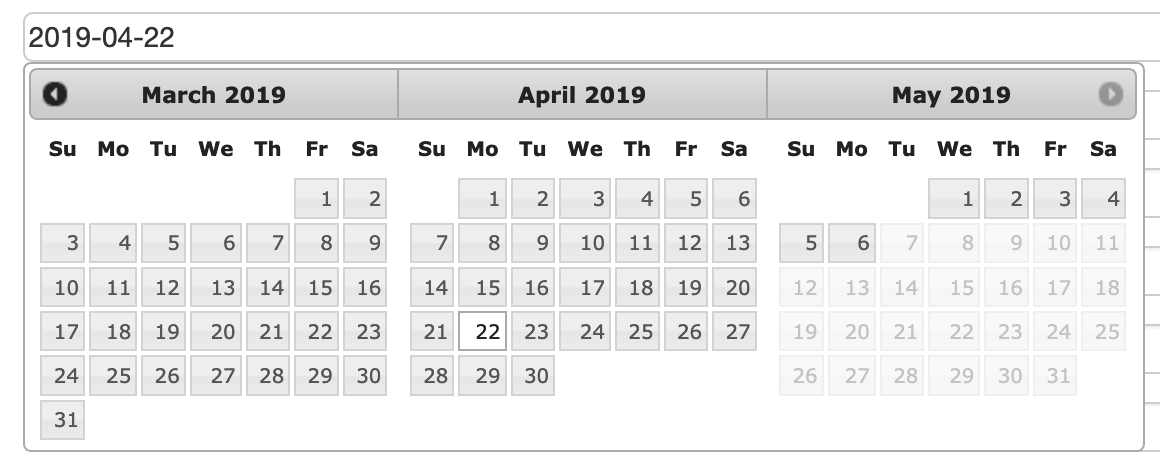
A narrowing of the results by limiting the search period to the last two weeks (i.e, starting from April 22) revealed a change. Alonso still whiffed on the most Chase zone pitches (13) and now had the second-highest whiff percentage (18.3%), but Wilson Ramos had the highest percentage (21.4%) and the second-most whiffs (9).

Mets whiffs in Chase zone — 2019 — ordered by whiff percentage

Good news was that Rosario’s percentage dropped about eight points to 12.0%, meaning he was likely showing more plate discipline.

Note: To limit the search to the last two weeks, for “Game Date >=” select April 22 from the calendar that appears, a sample of which is shown below.

Statcast Primer: Finding Hits on 2-Strike Count — 2018

In 2018, what Mets pitcher gave up the most hits when the batter faced a two-strike count (0-2, 1-2, 2-2, 3-2)?

Statcast Search Settings

  • PA Result: Home Run (4) — single, double, triple, home run
  • Season Type: Regular Season
  • Count: 2 Strikes
  • Season: 2018
  • Player Type: Pitcher
  • Team: Mets
  • Min # of Total Pitches: 100 Pitches
  • Sort By: Pitches
  • Change Total Pitch Parameters (2): Count and Plate Appearances

Results

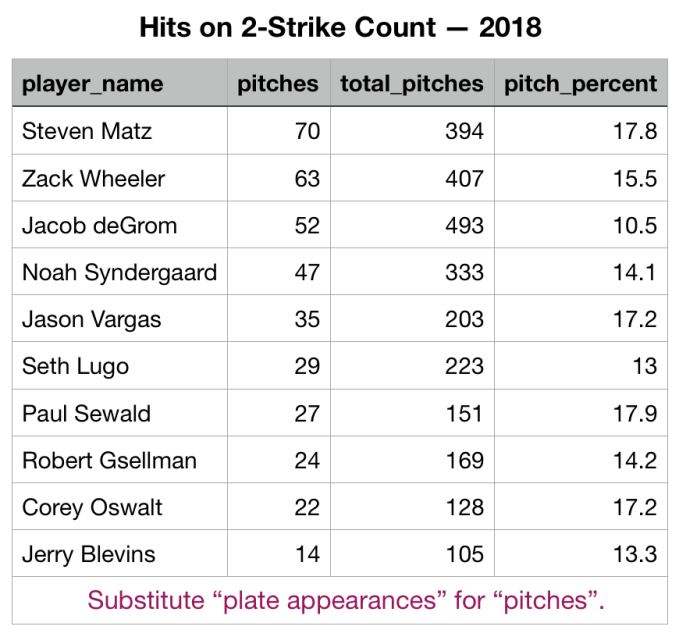
Steven Matz gave up the most hits on a two-strike count, 70, while tying for second in the percentage of hits given up (per plate appearances) on a two-strike count, 17.8%.

Among the starters, Jacob deGrom had the lowest percentage of hits given up (per plate appearances) on a two-strike count, 10.5%. That was also the lowest percentage in Major League Baseball among pitchers who faced at least 400 batters. Only two other pitchers had a percentage under 11%. Blake Snell was at 10.8% and Gerrit Cole was at 10.8%. The League average was 15.7%.