Possible Mets 2021 Starting Lineup — Position Players

First base: Pete Alonso. Despite his struggles at the plate in 2020 — the sophomore jinx steamrolled him — his performance in his rookie season locks him into this slot for 2021. His primary backup should be Dominic Smith, who had a breakout season in 2020 with an .852 OPS.

Second base: Robinson Cano exceeded my expectations. At age 37, while not justifying the trading of Jarrod Kelenic to get him, Cano hit .316 with an OPS of .896. His WAR, however, was just 0.9. Another negative is that Cano is slow. In the latest Statcast Sprint-Speed Leaderboard, for second basemen, Cano is rated the slowest at 24.8 ft/sec.

Shortstop: Andrés Giménez. Though he got only one vote in the 2020 Rookie of the Year voting, his star started to shine in 2020. In 2021, baseball-reference.com projects his OPS to be .769; whereas, they project Amed Rosasio’s to be .723. stolen bases OBP. Further, though the two are the Mets fastest runners, last season Giménez had eight stolen bases while Rosario had none.

Third base: Jeff McNeil. Since David Wright, the Mets have had problems stabilizing the hot corner. A potential contender at that position is free agent DJ LeMahieu, whom David Adler views as the best available free agent. LeMahieu can play first, second, and third so, like McNeil, he is a multi-position athlete.

Left field: Dominic Smith earned that position last season, so should start in left unless the universal DH returns to the National League. Then, Smith should start at first with Alonso becoming the DH because of Smith’s glove skills. Smith could have competition from Brandon Nimmo if the Mets sign George Springer to play center field.

Center field: George Springer. In 2020, Brandon Nimmo played the most games at this position (27), and even though his slash line was .280/.404/.484. In an sny.tv article, Danny Abriano wrote, “the Nimmo experiment in center field needs to end,” suggesting that he be relocated to left field. To support his claim, Abriano said, “of the 39 qualified center fielders in 2020, Nimmo was second-to-last when it came to OAA (Outs Above Average).” Abriano suggests as a replacement either Jackie Bradley Jr. or George Springer. Either would be an upgrade.

Right field: Michael Conforto. In 2020 he had the second-highest OPS on the Mets: .927. (Smith’s was .993, seventh-best in MLB.) Conforto’s fans include Mike Vaccaro, a writer for the New York Post, who said, “He has, at various times in his five years with the Mets, been projected a batting champion in waiting, an MVP in waiting, a top-10 MLB player in waiting.” Though we are still waiting, he is getting closer. Last season was the first time he hit above .300, his .322 average 69 points higher than his career average from 2015-2019 of .253.

Catcher: J.T. Realmuto. How good is he? Jim Salisbury wrote on nbcsports.com that the “two-time All-Star [is] widely considered the best catcher in the game for his work both behind and at the plate.” To sum up his skills: He can hit. He can catch. He can throw. And he runs faster than Christian Yelich, Kevin Pillar, and Jackie Bradley Jr.

New Statcast leaderboard hits a grand slam

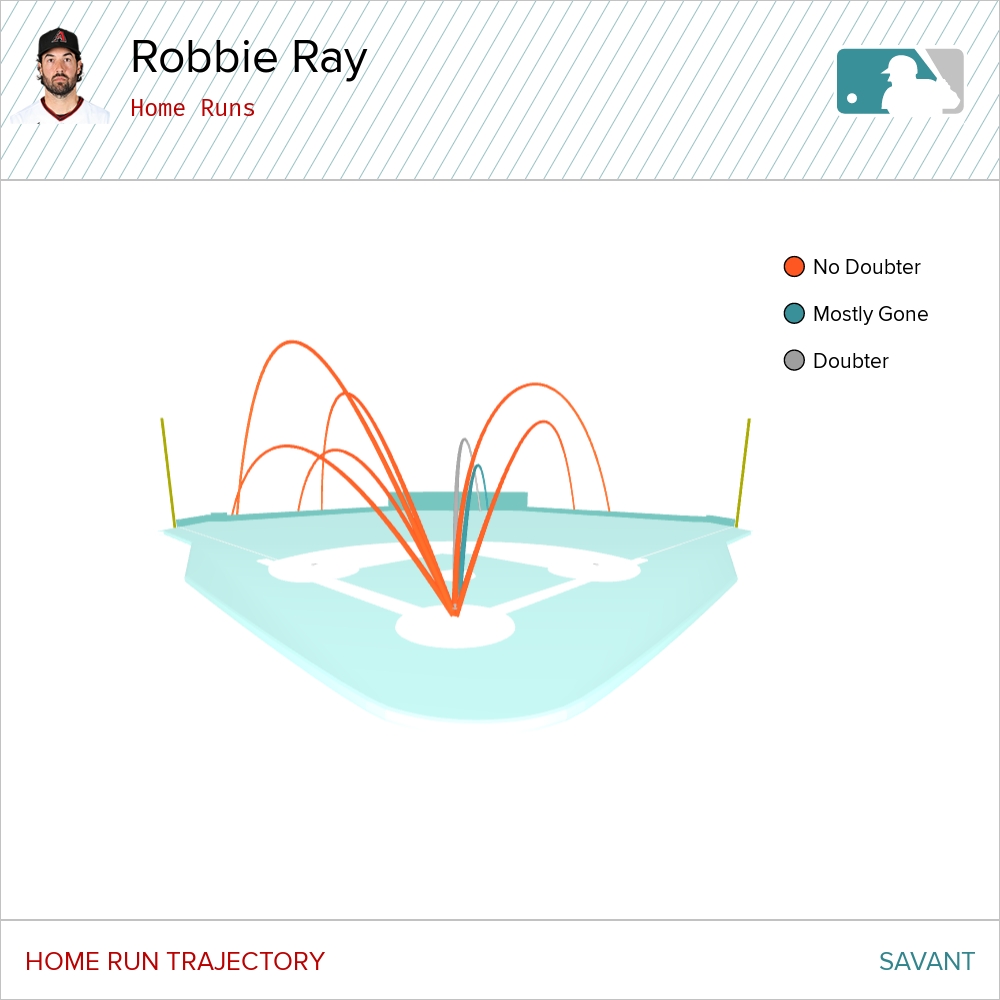
The latest feature added to Baseball Savant focuses on one of baseball’s most exciting plays: the home run. However, its creator, Daren Willman, tweeted, “Not all home runs are created equal.”

The leaderboard’s startup screen shows all those batters in 2020 who hit at least one long ball that would have been a home run in at least one of Major League Baseball’s 30 ballparks.

On August 9, before any of the day’s games have been played, Yankees slugger Aaron Judge is Major League Baseball’s home run leader with eight. In the Home Runs Leaderboard, if you click anywhere on a player’s row except on his name, details on all his homers in the season you choose will appear, each homer listed on a separate row.

Click on Judge’s row. Below his name should beS a table showing those ballparks where each long ball that Judge hit on the given date will be a homer. For example, on August 8 in Tampa Bay, the first long ball that Judge hit (against Sean Gilmartin) would have been a four-bagger in every ballpark, but the second long ball he hit (against Nick Anderson) would have been a homer in only 18 parks — video.

Therefore, for a long ball to qualify for (be included in) the Home Runs Leaderboard it must have been able to be a home run in at least one MLB stadium even if it was not a homer in the ballpark in which it was hit. Those batted balls are labelled as “Doubters,” “Mostly Gone,” or “No Doubters.”

  • If a batted ball would be a homer in fewer than 8 ballparks, it is a “doubter.”
  • If it would be a homer in 8 to 29 parks, it is “mostly gone.”
  • If would be a home run in every stadium, it is a “no doubter.”

That is why if you sum those three columns (“Doubters,” “Mostly Gone,” “No Doubters”) the total could be less than what is in the “Actual HR” column, which is the total number of homers the player hit, as occurs with Fernando Tatis Jr.’s numbers. He had six actual homers, but one “doubter,” three “mostly gone,” and six “no doubters.”

Finally, home run data is available for batters, pitchers, and teams for both 2019 and 2020.

Here is a sample of the kinds of questions that Savant’s Home Runs Leaderboard can answer.

Which player’s has the most “could-be” homers that could only be a home run in one stadium?

Which Mets’ player has hit the most actual and “almost” homers so far in 2020? Notice that one of Davis’ “homers” was a non-homer. I label that one a “Could Be” homer.

Who has hit the most “no doubt” home runs this season?

In 2020, which pitcher have given up the most “no doubters?”

The Home Runs Leaderboard is a great resource with eye-catching visuals for statistically-minded baseball fans. One thing that could make it even better is if you could get team data by both division and league. For example, now if I select “Mets” and “Pitchers,” I only get the results for the qualifying Mets pitchers.

Jacob deGrom is reviving memories of Tom Seaver

One of the best ways to judge a starter is by how many earned runs he gives up in his starts over his career.

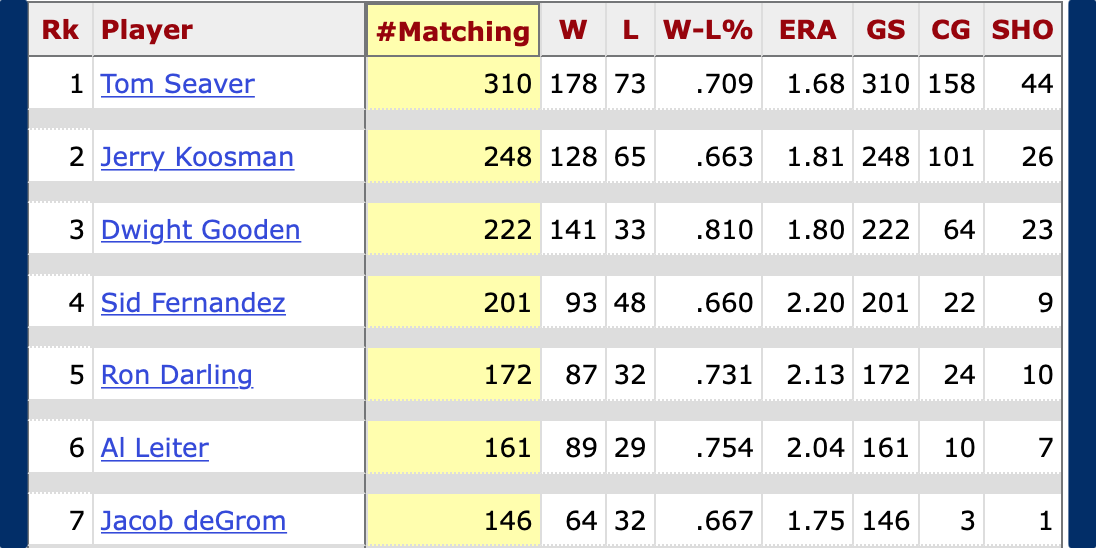
Only one Mets pitcher has started more than 300 games in which he gave up three or fewer earned runs: Tom Seaver. In them, he had an amazingly low ERA of 1.68. The only current Met in the Top 10 is Jacob deGrom.

Mets with number of starts in which 3 or less earned runs were given up
The data source for this post is stathead.com.

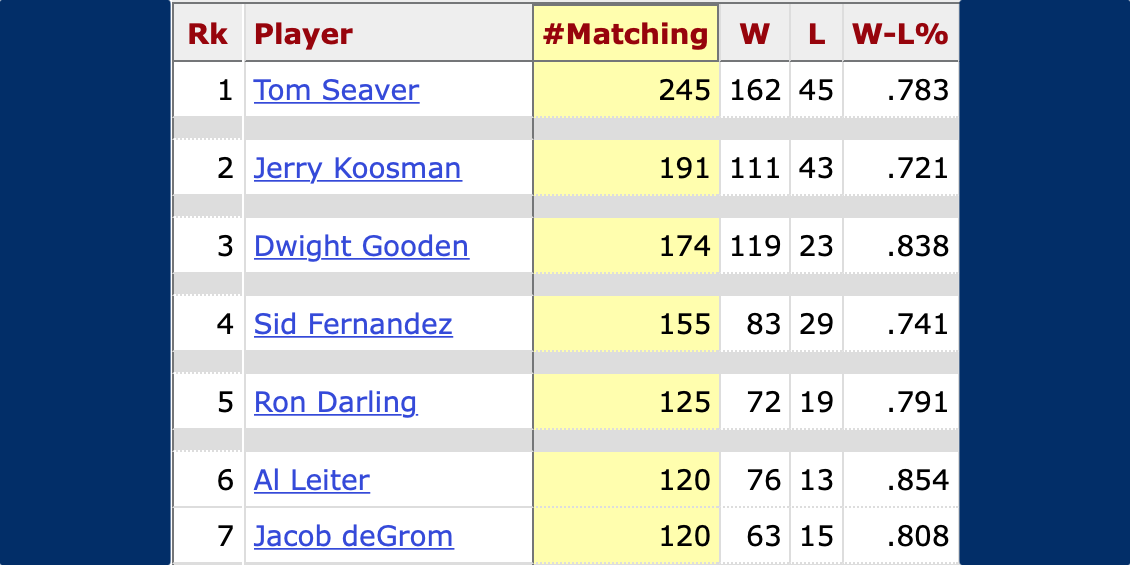
In 245 of his starts, Tom Seaver gave up two or fewer earned runs. But he did not have the highest W-L% among the Top 7. Al Leiter won almost 90% of the games in which no more than 2 runners crossed the plate w/o the aid of an error or passed ball.

Among Mets pitchers with at least 80 starts, only one had a W-L% greater than 90%. That was Bobby Jones, who pitched for the team from 1993-2000. In 85 starts he won almost 10 times as many as he lost (53-5).

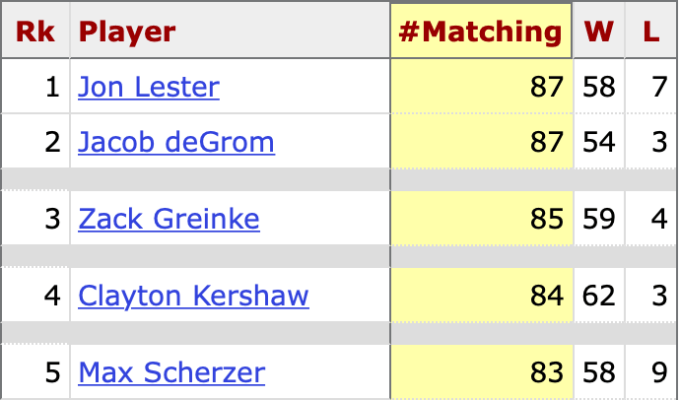
When the number of earned runs surrendered in a start reduces to no more than one, deGrom moves up to fifth place and his W-L% jumps to 94.7%. Further, half the pitchers in that Top 10 list are left-handed.

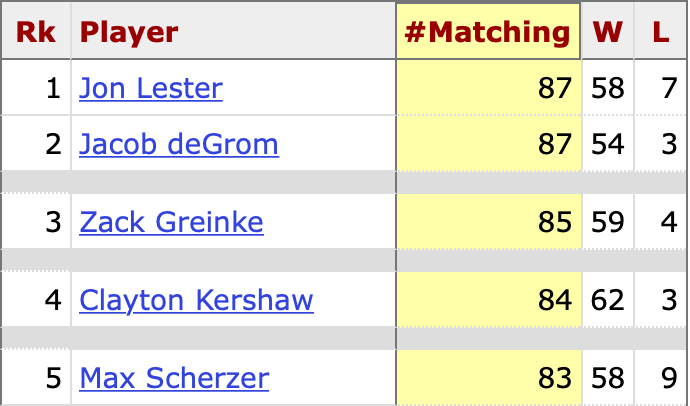
Since deGrom’s career began in 2014, only five MLB starters have pitched more than 80 games in which they surrendered no more than one earned run.

Jon Lester and Jacob deGrom tied for first; however, Lester had both four more wins and four more losses.

Two other Mets are in the Top 40, Marcus Stroman and Michael Wacha. Rick Porcello ranks 52nd, Noah Syndergaard 57th, and Steven Matz 91st. Ex-Met Zack Wheeler ranks 71st.

Statcast Searches: Four Core Components

This post shows how to use Statcast Search to do these investigations:

1. Find pitching data for all the pitchers in a league (National or American or both) in a year (limited by Statcast Search’s years of data)

2. Get the number of pitches each league pitcher threw to another pitcher in the same league.

3. Find how many pitches a specific pitcher threw to other pitchers.

4. Discover how many pitches a pitcher threw to every batter regardless of position.

When conducting a Statcast Search, four components are especially useful. One is Player Type. It contains 10 items: Pitcher, Batter, Catcher, 1st, 2nd, 3rd, SS, LF, CF, RF. The default value in Player Type is “Pitcher.”

The other three core items are Position, Batters, and Pitchers.

If you want to find pitching data for all the pitchers in the National League in 2019, use these four settings:

– Player Type: Pitcher
– Team: NL
– Season: 2019
– Season Type: Regular Season

If you search using those values, you will get data for 426 NL pitchers, starting with Stephen Strasburg, who threw the most pitches: 3,384.

The search results https://tinyurl.com/yawcthuu include these columns sorted by Pitches from a pitcher’s perspective: Pitches, Total, Pitch %, AB, Hits, BB, BA, SLG, EV(MPH),LA(°), Dist (ft). Pitches is the number of pitches thrown by the pitcher during all his mound appearances.

If instead of finding pitching data for all the pitchers in the National League in 2019, you want the number of pitches each NL pitcher threw to another pitcher you need to change the Position setting (second column) from the default of any position to “P” (Pitcher). https://tinyurl.com/ybwcxo3e

That reduces the number of results from 3,384 to 300. Those results show the number of pitches each NL pitcher threw to another pitcher. What is not immediately obvious is whether all the other pitchers were also in the National League though that appears to be the case. It is true.

Jacob deGrom heads the list. In 2019, with only pitchers in the batters box, he threw 220 pitches, holding those hitters to a .120 batting average.

Let’s make another setting change. This time in the Pitchers box (third column), Stephen Strasburg will be selected. (Position still is “P.”) Those results show how many pitches Strasburg threw to other pitchers: 208. By clicking his name, a pitch breakdown appears. https://tinyurl.com/ybxooty7

If Position is not set to a position, the results show how many pitches Strasburg threw to every batter regardless of position (3,384) and gives a pitch-by-pitch breakdown. https://tinyurl.com/y8aefb8u

But what if in the Batters box (third column), Stephen Strasburg was entered with nothing selected in Position? Then, the results show his hitting data for the 38 NL pitchers that he hit against. He was in the batters box against Sandy Alcantara for 22 pitches, the most, including one eight pitch at-bat that ended in a groundout. Strasburg has the most success at the plate against Braves pitcher, Touki Toussaint, getting a single and a homer in his two at-bat against Toussaint. Toussaint also was the only pitcher Strasburg got more than one hit against. The homer was both his only homer in 2019 and only the fourth in his 10-year career. Note: Setting the Position to “P” does not make any difference. https://tinyurl.com/ybnxnefa

And if there is a “P” in Position? The results are the same. https://tinyurl.com/yb8ao6v6