Only once was the #Mets opening-day starter under 21. In 1985, in his second season with the Mets, Dwight Gooden left the game in the 7th inning. The Mets won the game, 6-5, in the bottom of the 10th, on a Gary Carter home run off ex-Mets pitcher Neil Allen.
Whereas Dwight Gooden was the Mets youngest opening-day starter, Bartolo Colon and Tom Glavine were the oldest. Both were in their forties, Colon appearing once (2015) and Glavine twice (2006, 2007). In every game, they pitched six innings, gave up one earned run, and won the game. In Colon’s start, the losing pitcher was Max Scherzer.
The Mets have played 60 opening games, winning 29. Jacob deGrom has been named the starter in the 2022 opener, his fourth consecutive opening-day start. In his previous three, he won two, the no-decision start in 2021. In all three games, in 17 IP, he did not give up a run.
In the Mets 60-year history, on Opening Day the opposing starter has been left-handed 15 times. The last time, last year, the Mets lost 5-3. Before that, they had not lost on Opening Day against a left-handed starter since 1974. On April 7, the Nats expected starter is Patrick Corbin, a LHP.
On Opening Day from 1962-2021, the Mets have played 14 teams. They have played the Phillies the most, nine times, winning six and losing three, and have never lost a home opener to the Phillies, winning all five games.
The last time the Mets stole a base on Opening Day was in 2018. In the bottom of the fifth, Jay Bruce stole second base. The Mets won the game, 9-4, against the Cardinals. Travis Jankowski stole second in a season opener in 2020 with the Reds. ViewStatheadResults.
Two Mets pitchers started almost one-third of the team’s Opening-Day games. Tom Seaver started in 11 of them, winning eight, and Dwight Gooden started in eight, winning seven. @baseball_ref
Baseball Reference contains the Opening-Day lineups for all Mets opening games.
The Mets have had a lot of players behind the plate, “the game’s most demanding position,” according to Jesse Yomtov, starting with Hobie Landrith who, on April 11, 1962, caught the first pitch thrown by a Mets’ starter (Roger Craig).
Five catchers have stood out.
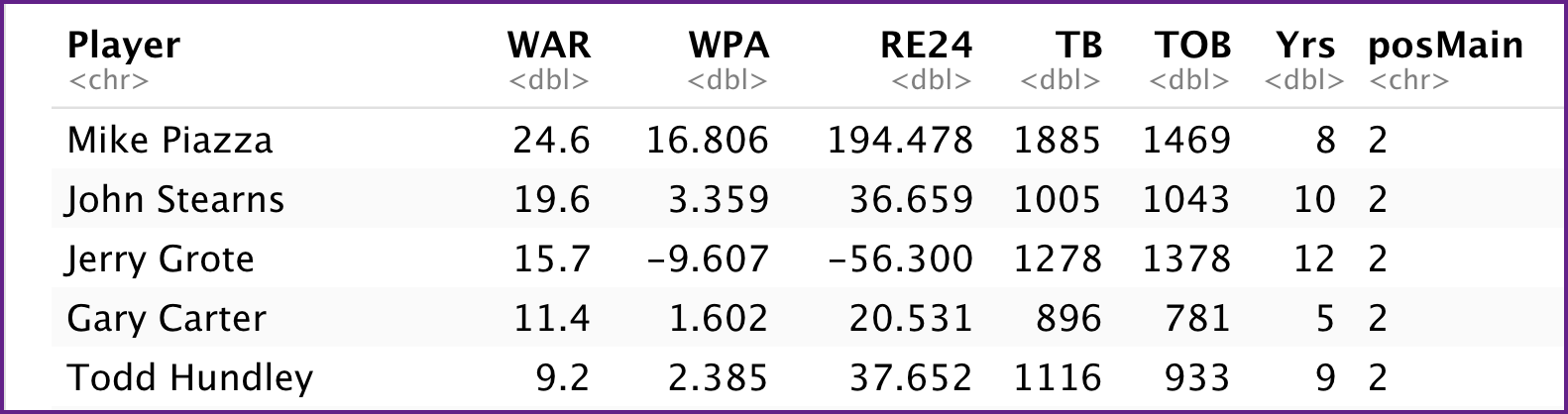
To choose them, five statistics were primarily used: WAR, WPA, RE24, Total Bases, and Times on Base (excluding by error) with WAR and WPA the two dominant ones in that order. In addition, their selection was based solely on their time with the Mets, not on their overall career, as a player could have played for multiple teams
Among the Mets top five catchers, two are in the Hall of Fame: Mike Piazzaand Gary Carter. Piazza played eight seasons for the Mets after playing seven on the Dodgers, Carter five after playing 11 for Montreal. Filling out the list are Jerry Grote, who played 12 seasons in the Big Apple, John Stearns, who played 10, and Todd Hundley, who played nine.
Sources: Stathead Baseball and Baseball Reference
Grote came closest to Piazza in Times on Base, only 91 apart; however, as a Met, Grote played four more seasons than Piazza who averaged getting on base 183.6 times a season versus 114.8 for Grote.
Based only on their Mets WAR number, the top two are Piazza and Stearns; however, when WPA and RE24 are taken into account, the difference between the two becomes quite significant. And Piazza separates himself even more from the others in Total Bases, having 607 more than the second-most — Grote’s 1278. But then, in his Mets career, Piazza amassed a .542 SLG. No one else in the group came within 100 points of that number.
Piazza had the third-highest JAWS rating among all catchers.
Twitter Poll
I found the tweet below after I completed the above write-up and was not surprised by Piazza’s landslide victory. He was one of the Mets most popular players.
Fun project at MLB dot com. Over the coming weeks, we're constructing an "all-time team" for every franchise, with input from you.
We'll start with an easy one: Who is the best catcher in Mets history?
Another stat, TOB/TB, helps lengthen Piazza’s lead over the rest of the field. Written about in 2016 by Rob Mains, the TOB/TB Number is calculated using this formula:
Multiply Times on Base by Total Bases.
Double it.
Divide the result by the sum of Times on Base and Total Bases.
Piazza’s TOTtb number of 1,651 was 325 points ahead of Grote’s with the average for the top five catchers 1,170.
Others’ Views
Tim Boyle, in his catcher comparison, made this comment about Mike Piazza:
“Piazza didn’t have a reputation for playing well defensively. As the years went on, he got worse. I’m not so sure anyone holds this against him. Piazza was far too amazing at the plate for anyone to criticize him for his weaknesses behind it.”
In contrast, Jennifer Khedaroo viewed Piazza’s defensive skill differently, writing
“In terms of defense, Piazza played well year after year. He was consistently in the top five for putouts, assists, double plays turned and runners caught stealing.”
And though Harold Friend agreed that Piazza was a better hitter than Gary Carter, he still pushed Piazza into second place among the best Mets catchers, Carter’s defensive skill giving him the edge:
“Gary Carter was the most valuable Mets catcher. Piazza will always be rated as the greater player, but Carter was more valuable to the Mets. Gary Carter was (and is) a world champion.
Piazza was the greatest hitting catcher ever. Although he was a good defensive player his first few seasons with the Los Angeles Dodgers, he was a defensive liability during his tenure with the Mets.”
Overall, Friend wrote, “Carter provided great defense, handled an excellent pitching staff magnificently and was a timely clutch hitter.”
In response to Friend, in my opinion the best measure of clutch hitting is WPA. For that stat, Piazza’s score was more than 10 times higher than Carter’s.
With regard to Piazza’s ability behind the plate, in an nj.com article, its author, Brendan Kuty, wrote that Hall of Famer Tom Glavine “said Piazza’s reputation as a bad defensive catcher is undeserved.”
“He did a lot of things well behind the plate,” Glavine said. “Yeah, he wasn’t the greatest thrower. That unfortunately translated into people thinking that some of this other game wasn’t as good as it was. He called a good game. He received the ball fine. He blocked balls fine.
But so often catchers are defined defensively on how well they throw and there’s much more that goes into just being a good defensive catcher than being able to throw. That aspect of his game, for whatever reason, garnered the extra attention and overshadowed the other aspects of his game.” (from Kuty article)
In 2021, the #Mets won only 37% of their away games compared with 53% of their home games. In home games, their team OBP was .323; whereas, in away games it was .307. #LGM@Stathead#MLB
For this search, you need to use Stathead Baseball’s Split Finders tool. It can be used to get both player and team data for both batting and pitching. When used for team batting, you can search one or multiple seasons. As I just wanted the data for a single season, I did a single season search.
Here is how to use Stathead Baseball to get the results in the above tweet.
Go to Split Finders > Team Batting.
Set Sort By to Descending and OBP.
Make Seasons“2021 to 2021”.
For Choose Split Type, select Home or Away.
For Choose A Split, select Home.
Under Team Filters, click or tap Choose a Team Filter.
Then, click or tap Team.
Click or tap AnyTeam
Select New York Mets.
Click or tap Get Results.
Under Current Search, you should see this: ▶︎ In the Regular Season, in 2021, For NYM, In the AL or NL or FL, Home (within Home or Away), sorted by greatest On-Base%.
To get the away game data, repeat the above steps, making this one change: 5. For Choose A Split, select Away.
View the Stathead results for home games and away games..
In a clutch situation, a closer need to shut the door, not allow the opponent to open and then run through them. The latter is what happened in yesterday’s Mets-Pirates game.
Let’s start by looking at his ERA as the season has progressed: – April: 2.00 – May: 3.97 – June: 2.38 – July: 12.60
Over the past 30 days, his performance based on his ERA has been on the decline. – Last 30 days: 8.38 – Last 15 days: 12.60 – Last 7 days: 27.00
In particular this season, Diaz’s performance in away games has been worse than in home games. – Home ERA: 2.45 – Away ERA: 6.75
In home games, his record is 3-1; whereas, in away games it is 0-3. Similarly, in day games, his record is 3-1; whereas, in night games it is 0-3.
Even more surprising are his slash lines for right- and left-handed batters. – Against right-handed batters: .275/.351/.362 – Against left-handed batters: .175/.303/.222
Diaz is at his best on two-strike counts. – 0-2: .200 (BA) – 1-2: .065 – 2-2: .200 – 3-2: .077
With regard to the effectiveness of his pitches, the run value when he throws his slider is -6; whereas, against his fastball it is +6. Run value reveals a pitch’s impact. The lower the value, the better.
Further, when he throws the slider, batters are hitting .180 with a .213 SLG, but when he throws his four-seamer, batters are hitting .268 with a .366 SLG. Those are the only two pitches Diaz has thrown this season with 63.1% of them four-seamers and 36.9% sliders.
Based on the above data, Diaz is at his best when he does not fall behind in the count, throws more sliders than four-seamers, faces left-handed batters, and pitches in home day games.



 Bats and Stats