Cano’s swing could be lowering his batting average

It’s being written that Mets second baseman Robinson Cano is not as good a hitter as he has been in the past. Here is some evidence that supports that assertion:

  • He never had an OBP under .300. His previous low was .305 in 2008. In 2019 it is .277. His lowest batting average was .271 in 2008. This season he is hitting .228.
  • His lowest slugging percentage was .410 in 2008. This season, it is .369.
  • His OPS is .646. He never before had an OPS below .700.

Is that evidence sufficient for someone to conclude that Cano is not the same hitter he was in previous seasons? Not yet.

Cano could be unlucky.

His xBA (Expected Batting Average) for 2019 is .268, 40 points higher than his actual batting average; however, that is under his prior season low of .271 in 2008.

In addition, this season, his BABIP is .270 (43 for 159). Fewer batted balls are resulting in hits. Only twice before (2008 and 2017) in his 15 seasons playing in the majors did he have a BABIP below .300.

Batting Average on Balls in Play (BABIP) is a statistic which measures how often non-home run batted balls (often called ‘balls in play’) fall for hits.

FanGraphs

“A ball is ‘in play” when the plate appearance ends in something other than a strikeout, walk, hit batter, catcher’s interference, sacrifice bunt, or home run,” according to FanGraphs.

The 2019 League average BABIP is .296, so Cano’s is 26 points or about 10 percent less than it.

Is he just having back luck this year? No. Cano is having trouble at the plate with balls he is not putting into play.

  • His K/PA ratio of .195 is the highest in his career. For his career, it is .126. Plus, his K% is 19.2%, the highest one in the last five seasons.
  • His HR/PA ratio of .018 is the lowest of his career, and this is in a season when so many homers are being that the reason why is under investigation. For his career, it is .035.
  • His BB/K ratio of .302 is his lowest since 2005. For his career, it is .522.

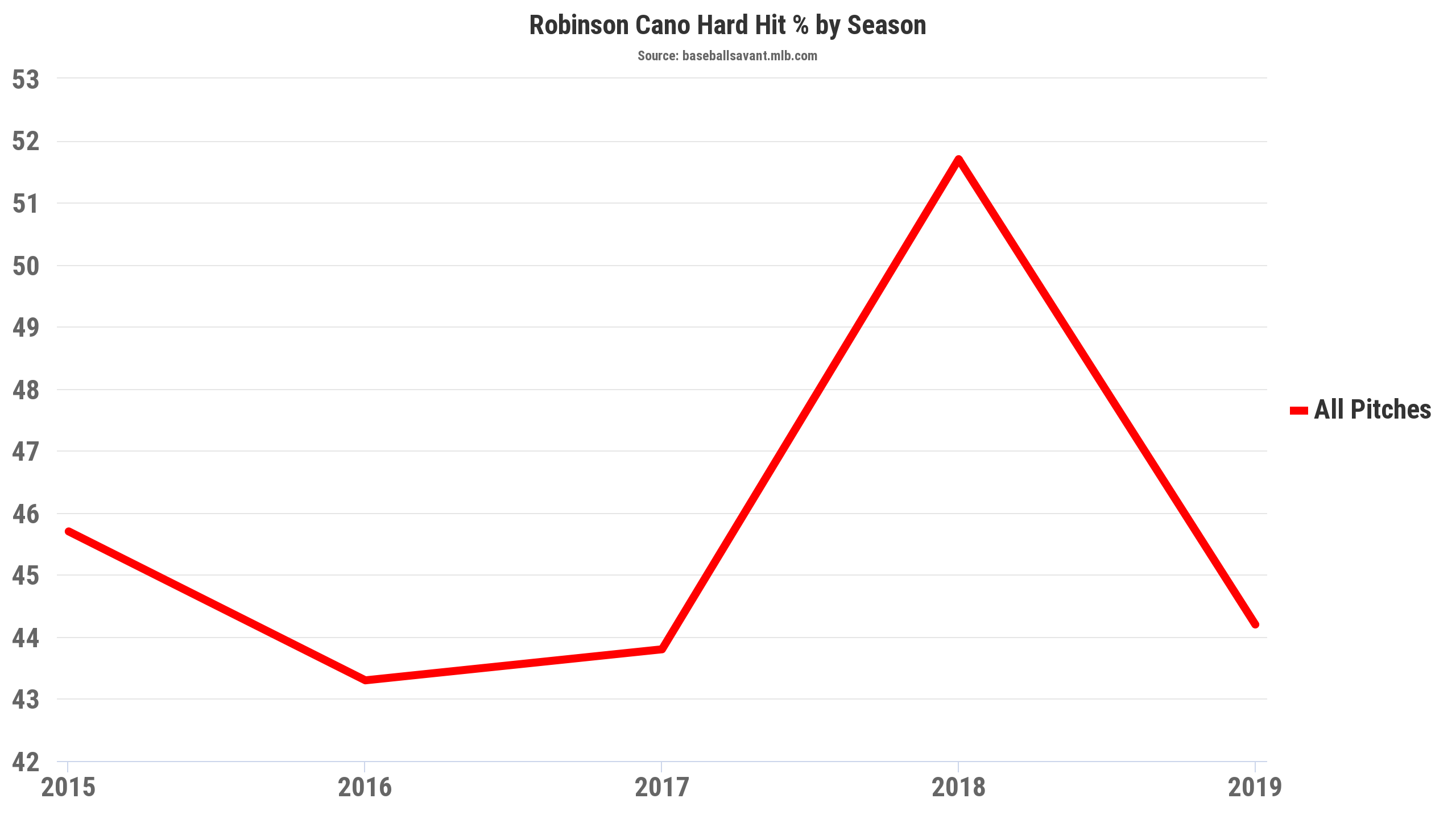
Is he still making solid contact? “The harder a ball is hit, the more likely it is to fall in for a hit,” according to FanGraphs. When Cano is hitting the ball, his average Exit Velocity of 90.6 mph is close to his average of of 90.8 mph from 2015 to today; however, his Hard Hit % is on the decline even though.

A hard-hit ball is one hit with an exit velocity of 95 mph. This season he has hard hit 72 balls, ranking him 114th in MLB.
Source: Baseball Savant

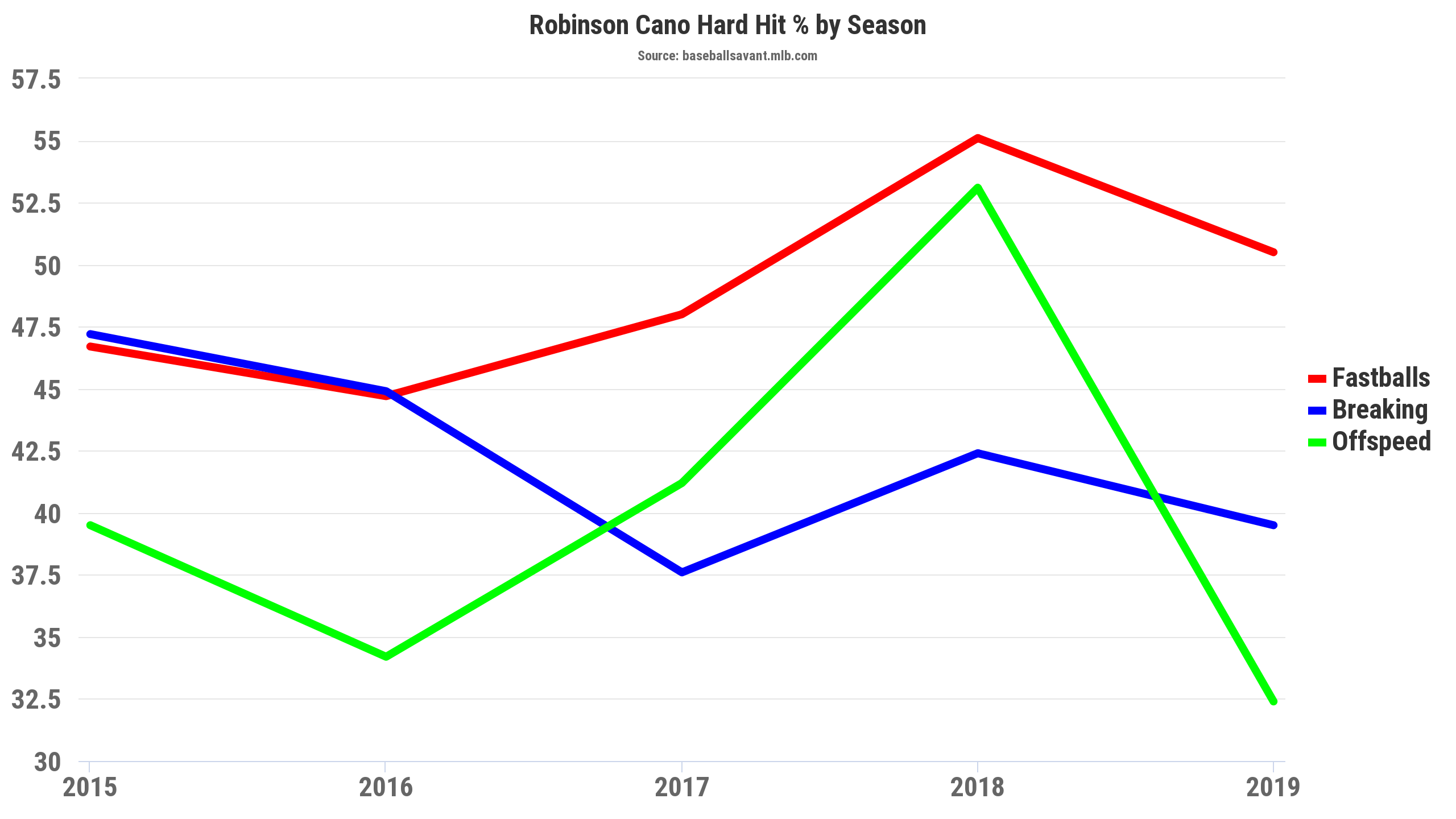
He is having the most trouble hitting off-speed pitches hard.
Source: Baseball Savant

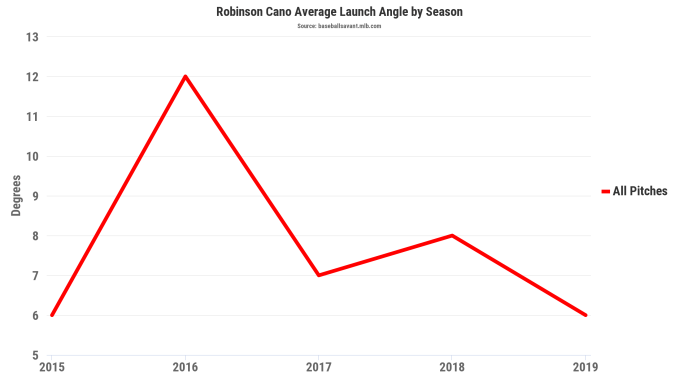
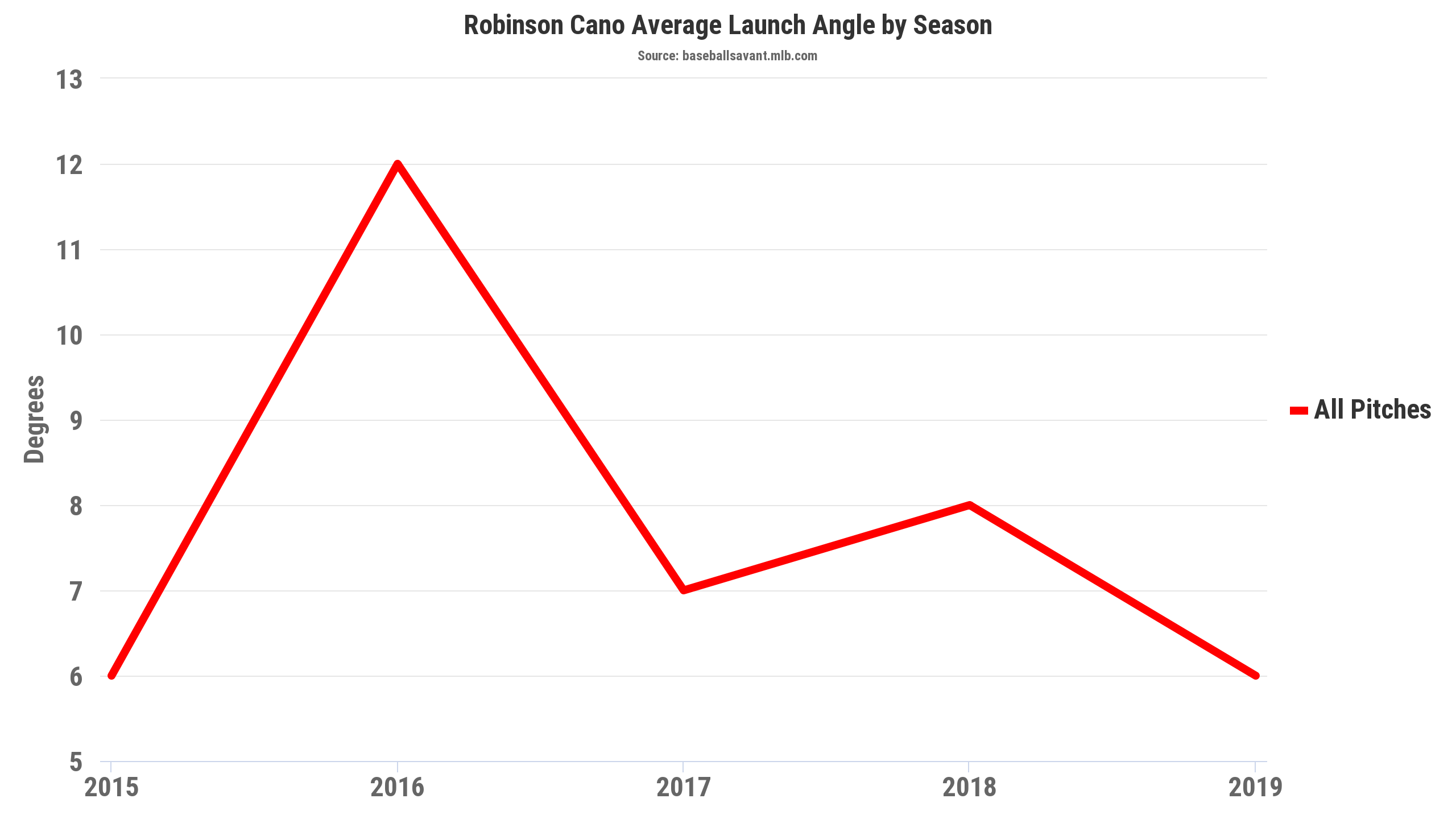
Other significant changes are these: (1) His GB% is the highest it has been since 2015, and (2) his average Launch Angle is the lowest it has been since 2015.
Source: Baseball Savant

Further, since 2018 he is getting much less loft on breaking pitches, and since 2016, the loft he is getting on fastballs has shown a steady decline.

Source: Baseball Savant

Given that his exit velocity has not slowed, could his launch angle drop be intentional?

In 2019, 52.1% of his batted balls were ground balls. His batting average on ground balls is .165 (14 for 85) where the League average is .240 or 75 points higher. In comparison, his batting average on fly balls is .222 — the League average is .302, and on line drives it is .574 where the League’s is .630.

The table below presents Cano’s batting average by launch angle.

Launch AngleAverage
>= 30°.083
20° to 30°.381
10° to 20°.692
0° to 10°.444
<= 0°.108
<= -10°.044

When he is either swinging down or with an attack angle above 30°, Cano is barely hitting .100 at best. Therefore, if he reduces the number of times he swings downward and tries to keep his launch angle within the 0° to 30° range, he should see improvement in his batting average. However, until his batting average starts rising it could help him, pressure-wise, if he bats lower in the order.
Statistical Investigation: Jeurys Familia

A FanGraphs article in 2017 titled “The Death of the Sinker” ended with this quote: “I don’t think the sinker’s gone,” [Jared] Hughes said. “I think teams might be trying to find a way to focus on velocity, but in my opinion, the sinker is the best pitch in baseball.”

This season, for Mets reliever Jeurys Familia, that has not been the case. Though his most-used pitch has been the sinker, thrown 47.1% of the time, it has not been his most effective one.

Stat Fact: His ERA is 7.81. That is the 5th highest ERA in Major League Baseball out of 167 qualifying relievers. Plus his BB/9 of 6.83 is also 5th highest in the majors.

Opposing batters are hitting .333 against his sinker, much higher than in the previous four years. (It was .204 in 2015). That is almost 40 points higher than the 2019 League average against sinkers of .294.

Stat Fact: Familia ranked 39th in opposing batting average among relievers who had thrown sinkers to at least 25 batters.

And since 2017, when Familia has thrown his sinker opposing hitters SLG has increased every year from .265 to .377 to .521. That is 256 points. Further, when the first pitch in an at-bat is a sinker, they are hitting .556.

Stat Fact: Familia also ranked 39th in slugging percentage among relievers who had thrown sinkers to at least 25 batters.

Compounding Familia’s problems is that fact that opposing batters have gotten more extra-base hits off his sinker, six, than his other three pitches combined.

Historically, the sinker has been known as the ground ball pitch. As Kepner wrote in his book, K: A History of Baseball in Ten Pitches, “Its allure was efficiency, not force. Throw it low for ground balls.”

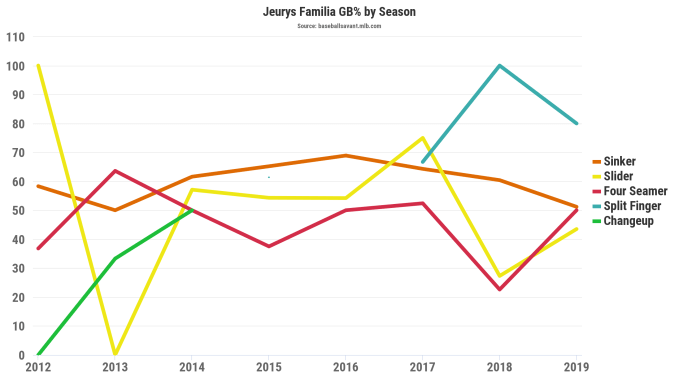
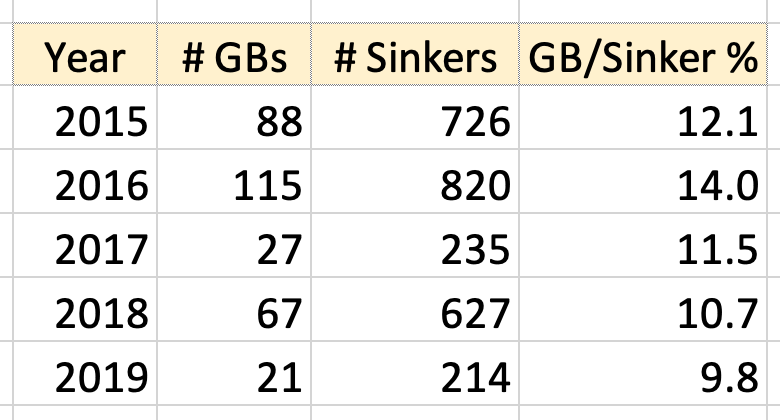
Familia has even had trouble doing that. Since 2016, the percent of his sinkers that have resulted in ground balls has steadily declined.

% of Jeurys Familia’s sinkers that resulted in ground balls

Surprisingly this season, as the GB% for his sinker has dropped, for his four-seam fastball — a pitch he has thrown only 12.9% of the time, it has increased. However, opposing batters are hitting .333 when he throws a four-seamer, the same opposing BA as for his sinker.

Source: Baseball Savant

Team Options

  • Reduce the number of sinkers Familia throws so it is no longer his main pitch. This season, against his slider batters are hitting .212, but he has only thrown it 27.9% of the time. Increase its usage.
  • Have him throw his four-seam fastball in place of his slider.
  • Determine whether a physical issue might be either causing or contributing to his pitching problems.

Update: The Mets have placed Familia on the 10-day injured list with a Bennett lesion for the second time this season. According to the book Baseball Sports Medicine, it is an “overuse” injury that can affect both shoulders and elbows. “Nonoperative treatment” includes rest, activity modification, and rehabilitation.” For more information on this injury and Familia’s earlier placement in May on the injured list, see Anthony DiComo’s mlb.com article.

Jacob deGrom’s changeup not working as well as in 2018

Jacob deGrom, in his first pitch to a batter, should not throw a changeup.

So far in 2019, seven times Jacob deGrom has thrown a changeup as the first pitch. Six of those times the batter got a hit (.857 average). All the hits were singles. Statcast Search

In contrast, in 2018 deGrom threw only 12 first-pitch changeups. Two resulted in hits. Both were singles for a .167 average. Statcast Search

This season, when any Mets pitcher have thrown an off-speed pitch as the first one, they fared much worse than the League average, opposing batters hitting .350 against them. Statcast Search

The problem is not just the Mets’. When any MLB pitcher started a pitch count with an off-speed pitch, opponents have hit .301 (188 for 625). Statcast Search

Jacob deGrom’s problems are not just with first-pitch changeups. This year, he has thrown a changeup as the last pitch 37 times. Eleven of them resulted in hits for a .297 opponents’ batting average. His problems with his changeup are surprising given that in 2018 deGrom was said to have the fourth-best changeup in Major League Baseball.

As a team, the Mets rank eighth-worst, 18 points above the League average, with opponents hitting their last-pitch, off-speed pitches at a .240 pace (93 for 387). Statcast Search Tampa Bay has the best team average, .167, more than a hundred points lower than the Mets.

League-wide, when an off-speed pitch is thrown as the last pitch, opponents are hitting .222 (1831 for 8258). Statcast Search

The Mets starter for whom an off-speed pitch has been the best out-pitch is Noah Syndergaard. Of the 67 he threw — all changeups — that ended an at-bat, only 12 resulted in a base hit, for an opponents’ batting average of .179. Statcast Search


Links to the Statcast Search pages are provided for those interested in seeing how the searches were done.

Mets pitchers faltering with first pitch

If one of the secrets to pitching success is to get off to a good start with each batter faced then the Mets’ pitchers seem to have forgotten it.

While this season the League’s first-pitch batting average against pitchers is .348 (2420 for 6952), opposing batters are hitting .391 (99 for 253) against the Mets’ first pitches.

Statcast Search results | baseballsavant.com

That is the third-highest in MLB, 43 points higher than the league average. Joining the Mets in the top six are the Pirates, Orioles, Marlins, and Reds. All have losing records.

Tops among the Mets starters is Jacob deGrom. Against him, opponents’ first-pitch batting average is .424 (14 for 33).

Statcast Search results | baseballsavant.com

In 2018, opponents batted .378 against him on first pitches, still quite high, but 46 points fewer than this season.

As the Mets’ playoff probability declines — it is now 17.5% — they might want to investigate why opposing batters are hitting a Ted Williams-like average against their starters.