Jacob deGrom’s changeup not working as well as in 2018

Jacob deGrom, in his first pitch to a batter, should not throw a changeup.

So far in 2019, seven times Jacob deGrom has thrown a changeup as the first pitch. Six of those times the batter got a hit (.857 average). All the hits were singles. Statcast Search

In contrast, in 2018 deGrom threw only 12 first-pitch changeups. Two resulted in hits. Both were singles for a .167 average. Statcast Search

This season, when any Mets pitcher have thrown an off-speed pitch as the first one, they fared much worse than the League average, opposing batters hitting .350 against them. Statcast Search

The problem is not just the Mets’. When any MLB pitcher started a pitch count with an off-speed pitch, opponents have hit .301 (188 for 625). Statcast Search

Jacob deGrom’s problems are not just with first-pitch changeups. This year, he has thrown a changeup as the last pitch 37 times. Eleven of them resulted in hits for a .297 opponents’ batting average. His problems with his changeup are surprising given that in 2018 deGrom was said to have the fourth-best changeup in Major League Baseball.

As a team, the Mets rank eighth-worst, 18 points above the League average, with opponents hitting their last-pitch, off-speed pitches at a .240 pace (93 for 387). Statcast Search Tampa Bay has the best team average, .167, more than a hundred points lower than the Mets.

League-wide, when an off-speed pitch is thrown as the last pitch, opponents are hitting .222 (1831 for 8258). Statcast Search

The Mets starter for whom an off-speed pitch has been the best out-pitch is Noah Syndergaard. Of the 67 he threw — all changeups — that ended an at-bat, only 12 resulted in a base hit, for an opponents’ batting average of .179. Statcast Search


Links to the Statcast Search pages are provided for those interested in seeing how the searches were done.

Mets pitchers faltering with first pitch

If one of the secrets to pitching success is to get off to a good start with each batter faced then the Mets’ pitchers seem to have forgotten it.

While this season the League’s first-pitch batting average against pitchers is .348 (2420 for 6952), opposing batters are hitting .391 (99 for 253) against the Mets’ first pitches.

Statcast Search results | baseballsavant.com

That is the third-highest in MLB, 43 points higher than the league average. Joining the Mets in the top six are the Pirates, Orioles, Marlins, and Reds. All have losing records.

Tops among the Mets starters is Jacob deGrom. Against him, opponents’ first-pitch batting average is .424 (14 for 33).

Statcast Search results | baseballsavant.com

In 2018, opponents batted .378 against him on first pitches, still quite high, but 46 points fewer than this season.

As the Mets’ playoff probability declines — it is now 17.5% — they might want to investigate why opposing batters are hitting a Ted Williams-like average against their starters.

Dodgers hammer Diaz despite his “excellent pitches”

During yesterday’s ninth inning loss, the Mets’ closer, Edwin Diaz, pitched batting practice for the Dodgers. As a result, his ERA in away games jumped to 4.50. At home, it is 2.19.

When he entered the game in the bottom of the ninth, the Dodgers had a 3.4% chance of winning, according to FanGraphs. Then, seven batters and one out later, the Dodgers won the game 9-8.

The graphic below shows how the game’s Win Expectancy shifted in the bottom of the ninth.

Source: FanGraphs

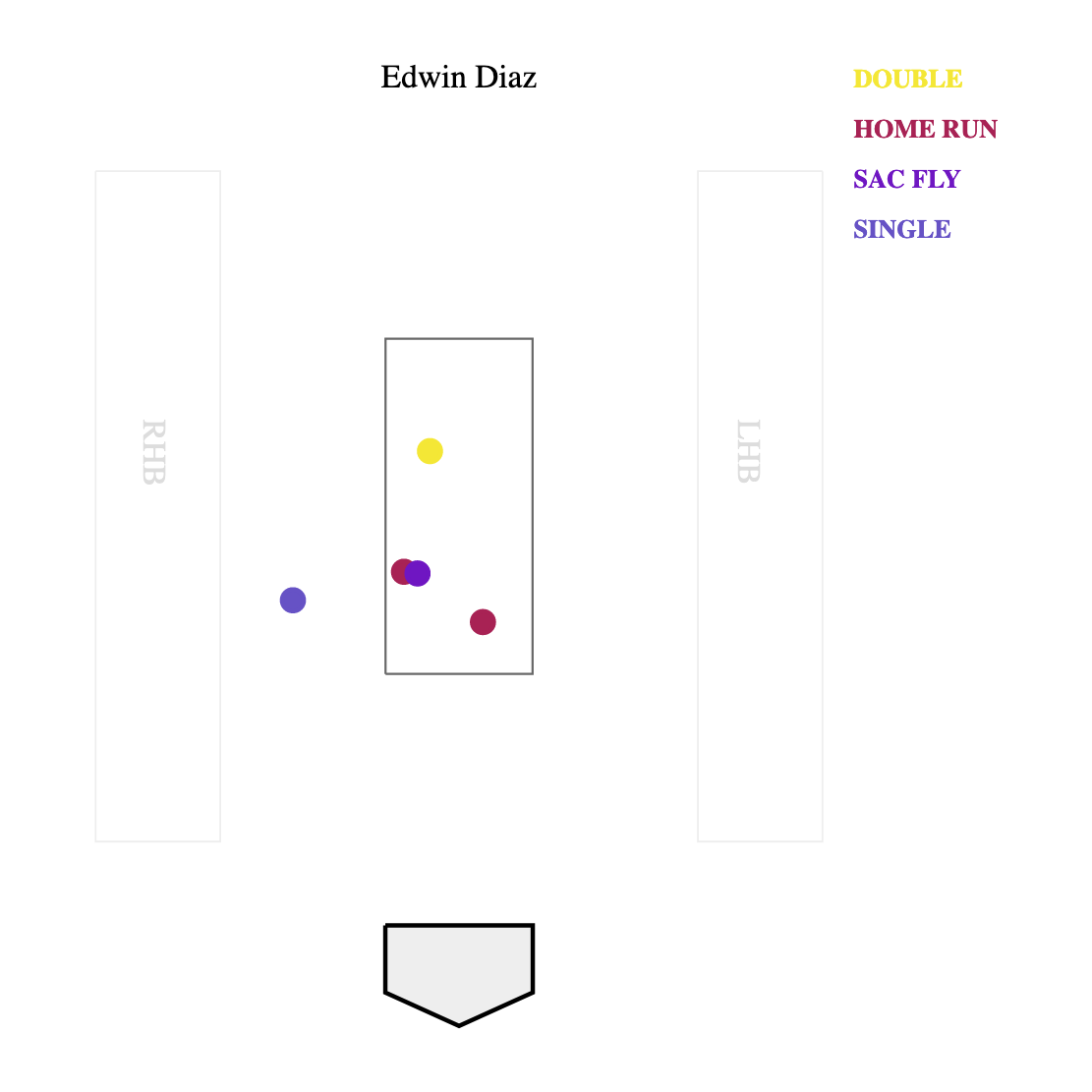
Five of the seven batters that Diaz faced had batted balls: two homers, two doubles, an intentional walk, a single, and a sacrifice fly. The chart below shows the pitch location of five of the six batted balls. (Justin Turner’s double is shown. Cody Bellinger’s is not.)

Source: Baseball Savant

Here are Diaz’s pitches the Dodgers hit (data from Baseball Savant):
– Home run: Slider (Pederson)
– Home run: Four-seam fastball (Muncy)
– Double: Slider (Turner)
– Double: Four-seam fastball (Bellinger)
– Single: Two-seam fastball (Beaty)
– Sacrifice fly: Slider

Diaz threw 30 pitches, but only four- and two-seam fastballs and sliders. Three of the nine sliders were batted balls, but only three of the 21 fastballs were. Further, while 11 fastballs were fouled off only one slider was. But the average exit velocity of the fastballs was 100.1 mph, four mph faster than for the sliders.

Only 43.3% of the pitchers were in the zone; however, the Dodgers swung at 84.6% of them, showing excellent plate discipline: They made contact with 81.8 % of them.

Source: Baseball Savant

The next chart, a spray chart shows how spread out the Dodgers’ batted balls were.

Source: Baseball Savant

After the game, Diaz said,

“Today was easily the worst day of my career, the worst game of my career, the worst game of the season for me,” Diaz said through an interpreter. “I thought I threw excellent pitches.”

Anthony DiComo — Edwin Diaz blows save against Dodgers | New York Mets

What makes yesterday’s outing particularly surprising is that, after it, left-handed hitters are batting .188/.250/.531 against Diaz; whereas, right-handed batters are hitting .286/.344/.429. Six of the seven Dodger batters that Diaz faced were left-handed.

As, if not more, surprising is that in away games, batters are now hitting .310 against him versus only .196 in home games.

Yesterday, while Diaz was on the mound, Wilson Ramos was behind the plate.

Statcast School: Barrels

Pete Alonso has quickly become one of the top power hitters in Major League Baseball, but unlike in days of old, how many homers a batter hits and how far he hits them are no longer the only measures of a slugger. Today, “barrels” has become a popular indicator.

In an article for Baseball Prospectus, Russell A. Carleton wrote that

Until Statcast, we didn’t have systematic (public) data on how hard a batter hit the ball. Now, we know how fast the ball was going when it left the bat and at what angle the ball was “launched.”

MLB defines a barrel as those

batted-ball events whose comparable hit types (in terms of exit velocity and launch angle) have led to a minimum .500 batting average and 1.500 slugging percentage since Statcast was implemented Major League wide in 2015.

Further, “To be Barreled, a batted ball requires an exit velocity of at least 98 mph,” according to MLB.

Here is MLB’s definition of a batted-ball event:

A Batted Ball Event represents any batted ball that produces a result. This includes outs, hits and errors. Any fair ball is a Batted Ball Event. So, too, are foul balls that result in an out or an error.

To start, in Statcast I sought to answer this question: Which players have hit the most barrels this season. To do the search, I used the search settings below.

Player Type: Batter
Season: 2019
Season Type: Regular Season
Quality of Contact: Barrel
Min # of Total Pitches: 25 Pitches
Sort By: Pitches
Change Total Pitch Parameters: Click “Plate Appearances.”

Being a Mets fan, the third name in the results drew my attention: Pete Alonso. Up to May 13 he has 20 barrels in 165 plate appearances (12.1%). The radial chart below shows the exit velocity and launch angle of each barrel. The area in red contains the barrels. To see the “live” chart, click this link.

Position your cursor over the topmost circle in the Barrels area. When you do that, the information in the image below should appear.

The three black circles indicate outs, the 17 green circles hits, so not every barreled ball is a hit. “KC” is knuckle curve.

Some other facts:

  • The average distance of Alonso’s barreled balls is 386.5 feet.
  • The average launch angle is 23.69º.
  • The average exit velocity is 109.8 mph.
  • The hardest-hit ball traveled at 118.3 mph.
  • The lowest launch angle was 12º: the result, a line drive double to left field.