⚾️ 🔥 Ryne Stanek lights up the radar gun at 100.1 mph with a four-seam fastball on April 8. He was flaming that day—three more pitches touched 99.
⤵️ ⚾️ Kodai Senga floats in a 68.5 mph curveball on April 1. Sixteen of his pitches caused swings and misses—but not that slow breaker. It drifted outside for a ball.
💥 At the Plate
⚾️🔥 Pete Alonso drives one to right at 114.5 mph. He pulls up at second, lucky not to get a speeding ticket for the ball’s exit velocity. His bat was electric that day—he launched a 113.4 mph homer, ripped another double at 113.1, and even clobbered a lineout that jumped off the bat at 107.1.
⬇️ ⚾️ Francisco Lindor gets jammed and taps one at just 31.9 mph—an ultrasoft grounder—back to the pitcher. The throw to first beats him before his engine can even get up any steam.
⤴️⚾⤵️ Baseball’s a game of contrast with its missiles to dribblers and whiffs to weak contact, the only sport that swings so wide.
The latest feature added to Baseball Savant focuses on one of baseball’s most exciting plays: the home run. However, its creator, Daren Willman, tweeted, “Not all home runs are created equal.”
Not all home runs are created equal… Check out our new @statcast leaderboard for home runs. Click each player row and it lets you see which home runs would go out if it was hit at another stadium. https://t.co/u3mWUxlAVKpic.twitter.com/HRHFnQAMeA
The leaderboard’s startup screen shows all those batters in 2020 who hit at least one long ball that would have been a home run in at least one of Major League Baseball’s 30 ballparks.
On August 9, before any of the day’s games have been played, Yankees slugger Aaron Judge is Major League Baseball’s home run leader with eight. In the Home Runs Leaderboard, if you click anywhere on a player’s row except on his name, details on all his homers in the season you choose will appear, each homer listed on a separate row.
Click on Judge’s row. Below his name should beS a table showing those ballparks where each long ball that Judge hit on the given date will be a homer. For example, on August 8 in Tampa Bay, the first long ball that Judge hit (against Sean Gilmartin) would have been a four-bagger in every ballpark, but the second long ball he hit (against Nick Anderson) would have been a homer in only 18 parks — video.
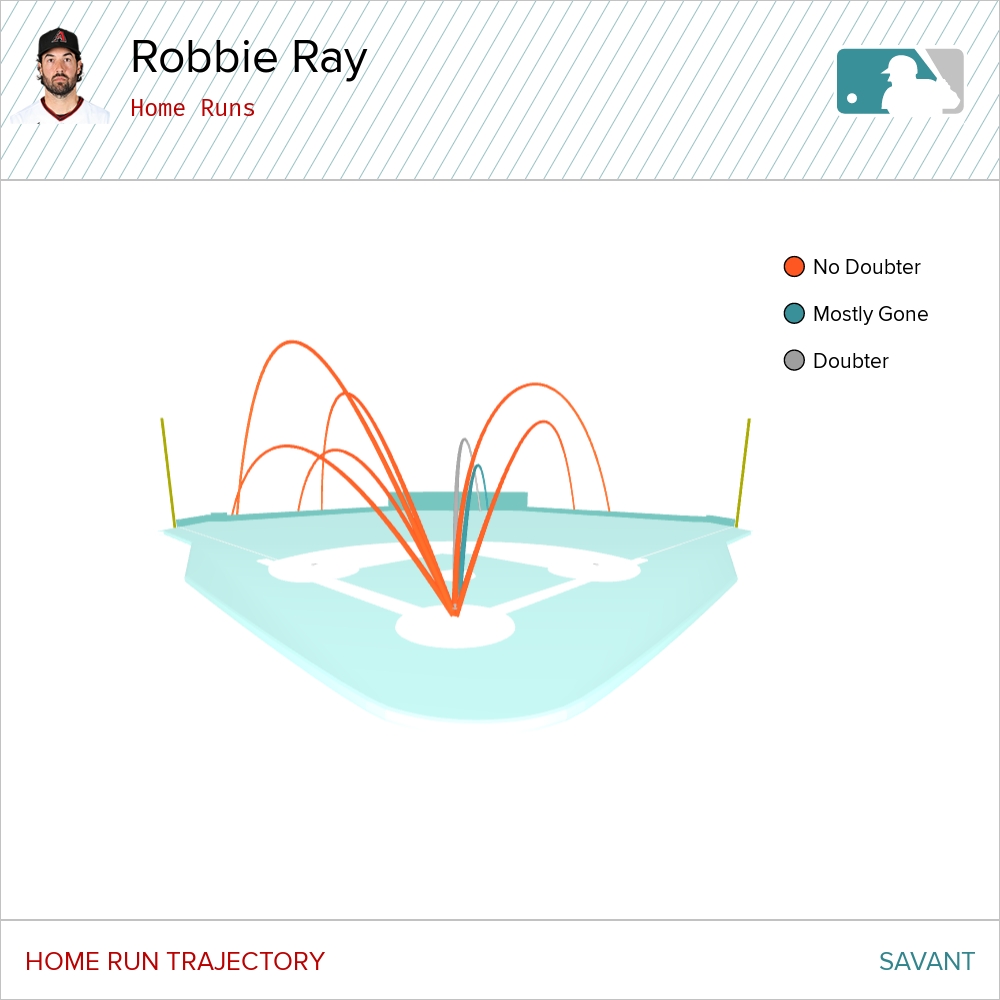
Therefore, for a long ball to qualify for (be included in) the Home Runs Leaderboard it must have been able to be a home run in at least one MLB stadium even if it was not a homer in the ballpark in which it was hit. Those batted balls are labelled as “Doubters,” “Mostly Gone,” or “No Doubters.”
If a batted ball would be a homer in fewer than 8 ballparks, it is a “doubter.”
If it would be a homer in 8 to 29 parks, it is “mostly gone.”
If would be a home run in every stadium, it is a “no doubter.”
That is why if you sum those three columns (“Doubters,” “Mostly Gone,” “No Doubters”) the total could be less than what is in the “Actual HR” column, which is the total number of homers the player hit, as occurs with Fernando Tatis Jr.’s numbers. He had six actual homers, but one “doubter,” three “mostly gone,” and six “no doubters.”
Finally, home run data is available for batters, pitchers, and teams for both 2019 and 2020.
Here is a sample of the kinds of questions that Savant’s Home Runs Leaderboard can answer.
Which player’s has the most “could-be” homers that could only be a home run in one stadium?
This is fascinating. Only 3 batted balls from Kris Bryant could have been a home run. And each of those would only be a HR in exactly 1 park.
Which Mets’ player has hit the most actual and “almost” homers so far in 2020? Notice that one of Davis’ “homers” was a non-homer. I label that one a “Could Be” homer.
In 2020, which pitcher have given up the most “no doubters?”
The Home Runs Leaderboard is a great resource with eye-catching visuals for statistically-minded baseball fans. One thing that could make it even better is if you could get team data by both division and league. For example, now if I select “Mets” and “Pitchers,” I only get the results for the qualifying Mets pitchers.
 Bats and Stats