Mets Pitching Will Be Tested Against Top-Hitting Cardinals

After dropping two of three to the Twins—despite both teams scoring 11 runs in the series—the Mets now face the Cardinals. That near sweep got me wondering: how have the Mets fared against St. Louis lately?

Since 2020, the Mets are 15–12 against the Cardinals, including just 5–8 at home. And the last time the Mets swept the Cardinals at home was all the way back in 1988. It’s the only time it’s ever happened. That was before Citi Field, before Mike Piazza, and before most of today’s roster was even born.

That 1988 Mets team won 100 games. Darryl Strawberry led the league with 39 home runs, and Dwight Gooden went 18–9 with a 3.19 ERA. It’s been a while.

This season, the Cardinals are sitting at 9–9, right in the middle of the NL Central, while the Mets lead the NL East at 11–7. But here’s the twist: the Cardinals lead the majors with a team batting average of .280. The Mets? They rank 22nd at .219—a 61-point gap.

So how are the Mets winning? Pitching. Until the Twins series, their staff had been in lockdown mode, keeping runs off the board and covering for an offense that acted like it had to pay a silent penalty every time it reached base.

Seven Mets batters are barely treading water at the plate. Four haven’t even cracked .200—and one is barely visible:

  • José Siti: .050 (That’s not a typo.)
  • Mark Vientos: .145
  • Tyrone Taylor: .163
  • Starling Marte: .167
  • Brett Baty: .175
  • Jesse Winker: .200
  • Brandon Nimmo: .203

If I hit like that in Little League, I never would’ve made it off the bench.

And while batting average isn’t the most fashionable stat these days—on-base percentage is the current darling—it’s still hard for me, as an old-school fan, to ignore how poor these numbers are.

Where does that leave us for tonight’s game? Griffin Canning is starting for the Queens men. He faced the Cardinals once last season, throwing six innings for San Diego and notching the win. Before that, in two other starts—one in 2023 and one in 2019—he split the results, with one win and one loss. Given his win against the Cardinals last year as a Padre and the Mets’ adjustments to his pitching, I’m hoping Canning can keep them from outscoring the Mets tonight during his time on the mound.

Why Bat Speed Alone Doesn’t Make a Great Hitter

When we see a home run crushed into the upper deck, it’s easy to think: “That guy swings so fast—no wonder he hit it so far.” And there’s some truth to that. Bat speed is a huge asset. A fast swing can launch the ball with serious power—if the hitter makes clean contact.

But that’s the key: contact.

Hitting a baseball—especially a fastball—takes more than raw bat speed. And if you ask some of the game’s best hitters, they’ll tell you the same.

Bat Speed = Power Potential

Bat speed gives hitters potential. Faster swings create more energy on contact, leading to higher exit velocities—the speed the ball leaves the bat. That’s what turns hard line drives into doubles and long fly balls into no-doubt home runs.

But all the bat speed in the world means nothing if the hitter misses.

The Real Challenge: Timing, Balance, and Adjustments

A 95-mph fastball can travel about 139 feet-per-second, so it will reach home plate in about 0.43 seconds. In that tiny window of time, a hitter must:

That’s what makes hitting so difficult—and so impressive when it’s done well.

Tony Gwynn, one of the best contact hitters in baseball history, wasn’t known for explosive bat speed. But his pitch recognition, timing, and ability to adjust his swing to where the ball was going was unmatched.

Adjustments Are Everything

Modern hitters like Juan Soto or Freddie Freeman show what it means to combine bat speed with elite control. Soto has excellent bat speed, but what really sets him apart is his ability to track pitches deep into the zone and adjust at the last moment.

Freeman is known for his smooth, controlled swing. He’s not just trying to hit the ball hard—he’s trying to hit it well. And he adjusts to pitch location better than almost anyone in the league.

In contrast, some young players come up with massive bat speed but struggle at first in the majors because they’re out of control or can’t read pitches. Bat speed doesn’t help when you’re swinging at the wrong pitch.

For example, this season, the Mets’ Brett Baty has the second-fastest bat speed at 75.8 mph, per Baseball Savant, just behind Pete Alonso’s 76.6. However, Baty is hitting just .111—the lowest batting average on the team.

Why is Baty still starting at second base? Mets manager Carlos “Mendoza said, Baty is going to continue to receive chances because ‘we believe in the player … there’s tools, there’s a lot to like there.’”

So, What Makes a Great Hitter?

Bat speed is important—but it’s not enough on its own. Great hitters:

  • Time the pitch perfectly
  • Stay balanced so they can swing with control
  • Adjust mid-swing to the pitch’s location

That’s why someone with average bat speed but who’s shown elite timing and pitch recognition—like a Jeff McNeil—can consistently produce, while others with top-tier bat speed might flame out.

The Bottom Line

Bat speed gives you power potential. But hitting ability turns that potential into results.

It’s not just about swinging fast—it’s about swinging smart.

For more related to this topic, check out Enos Sarris’s article, “What Can Hitters Actually See Out of a Pitchers Hand?”

Pitchers Fear Juan Soto’s Bat

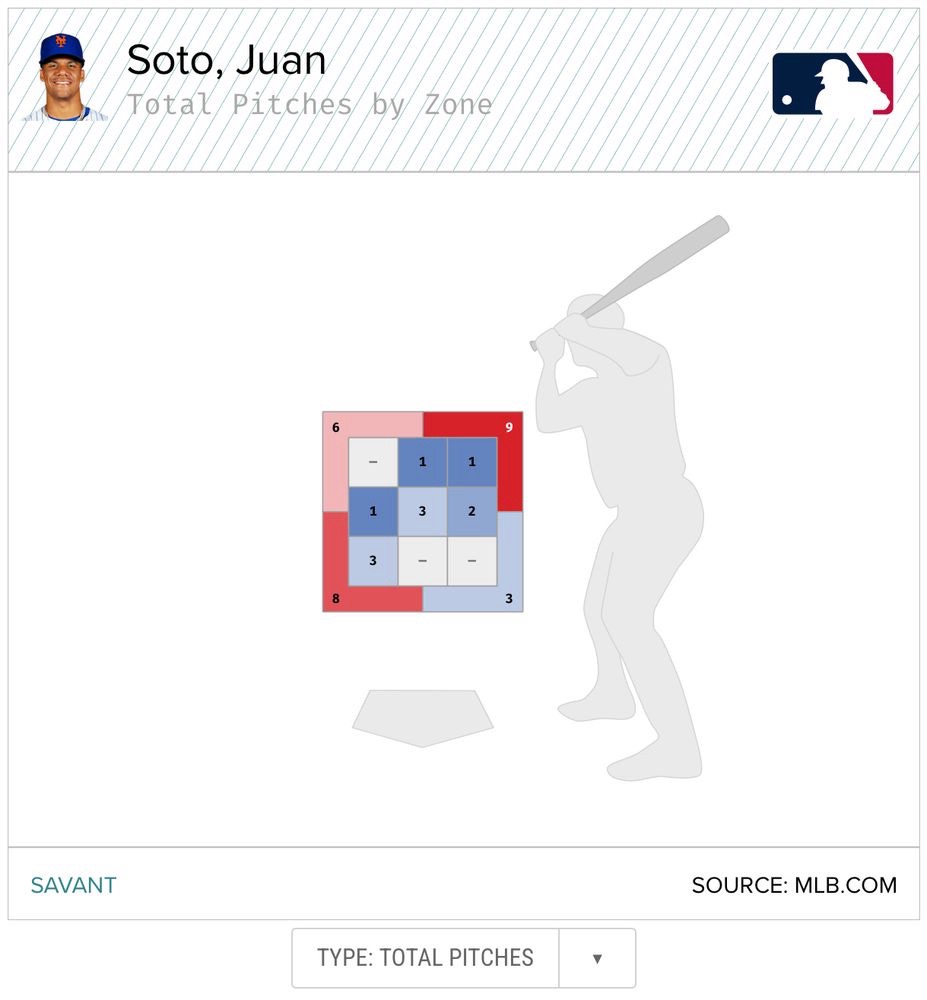
Of the 37 pitches thrown so far to Juan Soto, 26 have been outside the strike zone with eight of them low and away and nine high and inside. That shows the respect pitchers have for Soto’s bat.

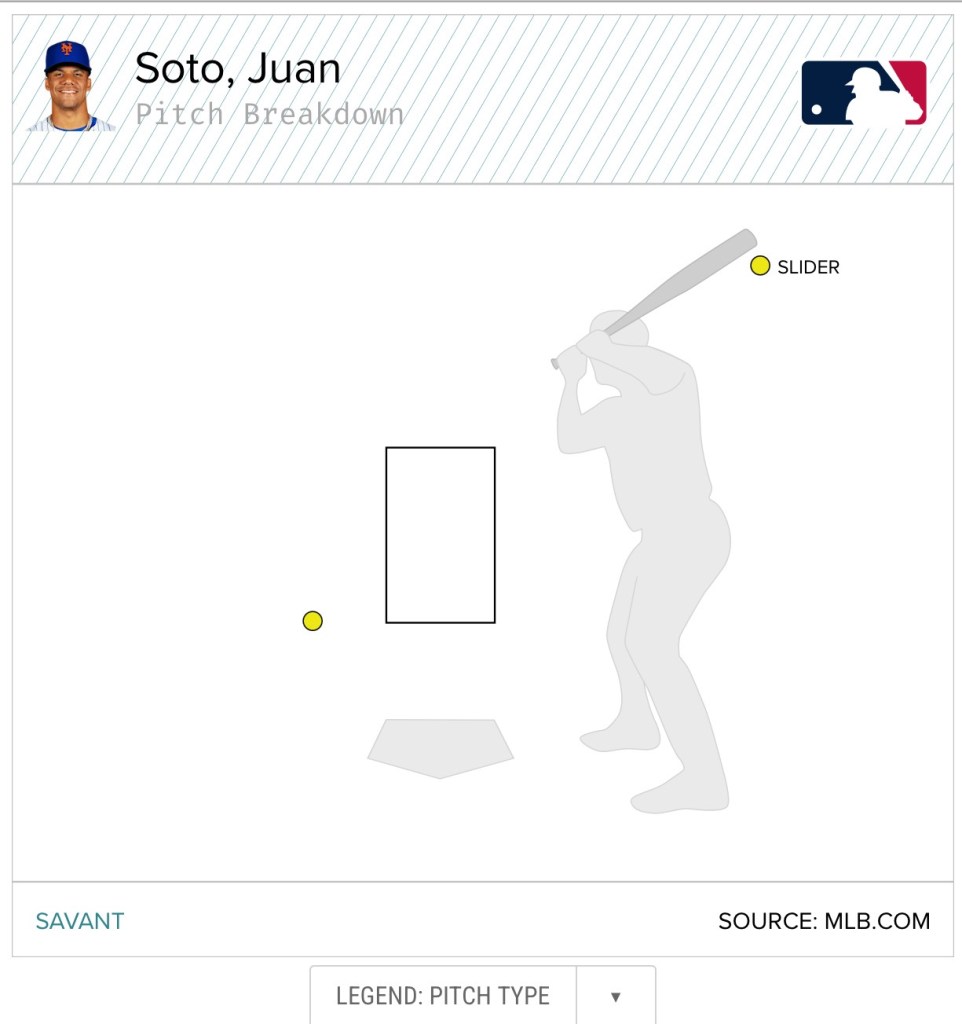
Of those 17 pitches, Soto swung at and missed just one. Unfortunately, that was the strikeout pitch that Josh Hader threw in the ninth inning of the Mets opening game.

In 2024 with the Yankees, Soto’s OBP against sliders was .344. That was the 16th highest OBP on Baseball Savant among all batters who had been thrown at least 400 sliders. The best in MLB was Aaron Judge (.416) and on the Mets — J. D. Martinez (.299). Pete Alonso’s OBP on sliders was just .214, sixth lowest, while the MLB average OBP was .276.


All the data is from Baseball Savant.

Juan Soto: Can He Break Mets OBP Record?

Since 1962, only 13 Mets who have played in at least 100 games in a season have had an OBP of .400 or above. The first was Richie Ashburn in 1962. His .424 OBP was not topped until 36 years later when John Olerud had a .447 OBP, a number no other Met has come close to through 2024.

Mets top OBPs in a season

Mets Top OBPs

That might change this season. Juan Soto, one of only two active players with an OBP >= .400 over at least 100 games in six seasons — the other is Mike Trout — is now a Met. However, Soto exceeded Olerud’s .427 OBP just once when he reached .465 in 2021 with the Nationals. In his other five seasons, Soto’s highest OBP was .419, accomplished last season with the Yankees.

Active players with most seasons with OBP >= .400 & Games >= 100

Among the active Mets players besides Soto, only one had an OBP >= .400 in at least 100 games in a season, Brandon Nimmo doing it once, but that was seven years ago when his OBP was .404.


Justin Turner played for the Mets from 2010 through 2013. During those years, his highest OBP was .334. After the 2013 season, he became a free agent and signed with the Dodgers. In three of his season with them, he had an OBP over .400 three times, playing more than 100 games in each.

❓I’ve wondered why he couldn’t hit like that with the Mets.


The data in the tables is from Stathead Baseball.