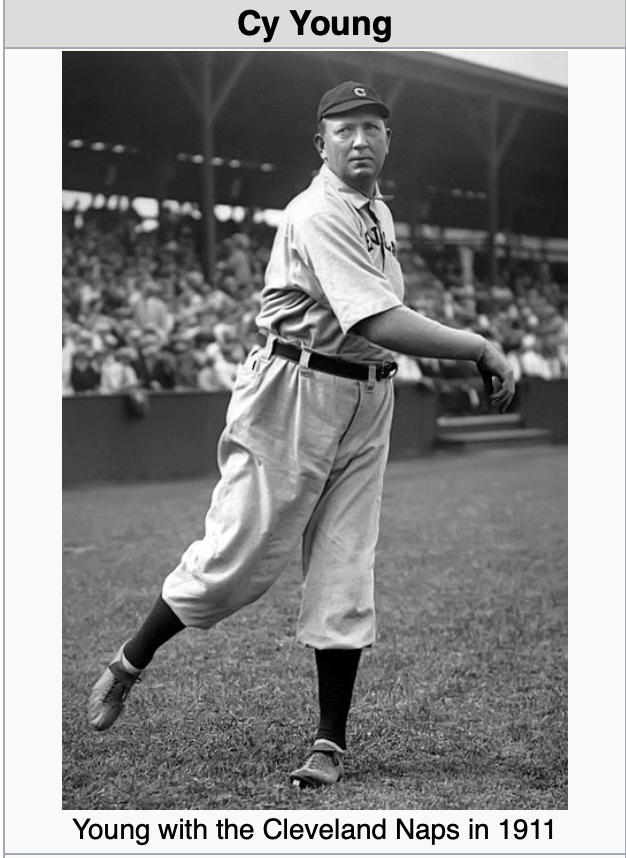
Cy Young Lives On

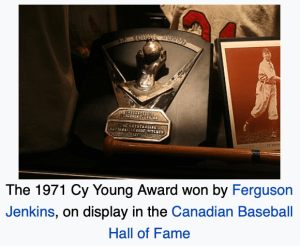
For more than 60 years, baseball has recognized its mound stars with a plaque that memorializes the achievements of a man whose 22-year career began in 1890.
When he retired at age 45, Denton True “Cy” Young had won 511 games and, until his next-to-last year in 1910, never lost more games in a season than he won.

Young’s greatest achievement may have come on May 5, 1904, when at the age of 37 he pitched the first perfect game in American League history – just the third in the major leagues and the first from the 60-foot-6-inch pitching distance. 

https://sabr.org/bioproj/person/dae2fb8a

Young died in 1955. A year later Major League Baseball awarded the first Cy Young Award, to Don Newcombe, who got 10 of the 16 first-place votes.

Since Newcombe, 117 more pitchers have won the prize.

During those first 11 years, just one pitcher won it more than once. Sandy Koufax won it three times. While others won it three times, only Roger Clemens (7), Randy Johnson (5), Greg Maddox (4), and Steve Carlton (4) won it more than three times.

Koufax was also one of five winners who pitched for the Los Angeles Dodgers, the Dodgers winning the prize five years in a row.

Further, five of the first 11 winners made it to the Hall of Fame: Warren Spahn, Early Wynn, Whitey Ford, Don Drysdale, and Sandy Koufax.

In 1966, Koufax was the last sole winner in a season. After his final receipt of the award, it was given to the best pitcher in each league.
Cy Young won 477 complete games, fully 60 more than Walter Johnson. Only five times did he win a game that he had started but not completed.

https://sabr.org/bioproj/person/dae2fb8a

At first, those winning it were starters who had won at least 20 games. That ended in 1973 when members of the Baseball Writers’ Association of America awarded it to Tom Seaver though he had a 19-10 record.

A year later, the first reliever won the Cy Young. Mike Marshall, pitching for the Los Angeles Dodgers, finished the 1974 season with a 15-12 record. He stood on the mound in 106 games, 30 more than Rollie Fingers, and pitched in 208.1 innings, starter’s numbers. So he averaged just under two innings a game. Despite all those appearances, his ERA was just 2.42.

Though Marshall had 21 saves, he did not lead the lead in that category, coming in second to Terry Forster who had 24 in 59 games. Despite being the runner-up in saves, Marshall was named the The Sporting News’ Fireman of the Year. 

After Marshall, eight other relievers have won the Cy Young, but none since another Dodger, Eric Gagne, received it in 2003.

Among all pitchers, both starters and relievers, only 11 have won the award in back-to-back seasons. Among them is Jacob deGrom, Mets standout, who received it in both 2018 and 2019, winning 21 games. However, unlike Gaylord Perry, those wins were not in one season but two, 10 in 2018 and 11 in 2019. Those two win totals were the lowest ever for a Cy Young Award winner who was a starter.

Cy Young threw a baseball until his right arm could no longer obey his mind’s commands.

“All us Youngs could throw,” he said. “I used to kill squirrels with a stone when I was a kid, and my granddad once killed a turkey buzzard on the fly with a rock.”

https://www.baseball-almanac.com/quotes/quoyung.shtml

He was inducted into baseball’s Hall of Fame in 1937.

On his tombstone, above his name and that of his wife, is a winged baseball.
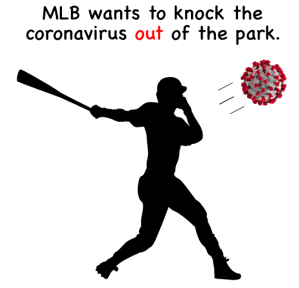
In 2020, the game will change — so must we

The world is facing a foe whose challenges make hasty responses very risky.

While the president favors haste as he seeks to sow “division and confusion” — his way of dealing with complexity and uncertainty, Major League Baseball is taking a more deliberate approach.

Player by Lucky Creative/Shutterstock.com

MLB released a 67-page report stating what needs to be done to protect players and support personnel when the sport resumes. Among the issues covered in the report are how often to test, what to do when someone tests positive, and how to lessen chances of both players and other team personnel both contracting and spreading the virus.

Among the proposed restrictions according to The Athletic article are “No spitting, using smokeless tobacco and sunflower seeds in restricted areas. Any physical interactions such as high-fives, fist bumps and hugs must be avoided at club facilities.”

The game of baseball will be different.

And as MLB is offering its resumption plan, the Miami Marlins have reopened their facilities for player use.

A bigger problem is that even if MLB fully implements what is in its report that will not stop the virus’ spread. Further, as Andy McCullough and Marc Carig stated in an article in The Athletic,

the protocols may not be enough to blunt an almost inevitable outcome, the price for transporting thousands of people around the country to play games while a highly communicable virus still lurks throughout the nation: People in baseball will still get sick.

https://theathletic.com/1827299/2020/05/21/infections-are-going-to-happen-experts-talk-risks-reality-of-mlbs-protocols/

And that possibility is on players’ minds.

If players expect to receive a full season’s salary for a partial season of play, there might not even be baseball this year.

Further, for how long can games be played in empty ballparks before the fans watching TV games start losing interest? In a New York Times essay, Jeré Longman writes about the importance of fan-filled seats in stadiums:

For those watching on television, spectators are necessary surrogates. They provide jersey-wearing pageantry, face-painted tribalism and adrenaline for the players. Their responses of jubilation and anguish verify our passionate responses. Their voices become our soundtrack, collectively rising in anticipation, thunderously exhaling in joy or disapproval.

Without those spectators, those on-site enthusiasts, even televised games may lose some of the magnetism they have had.

But then, they might not.

Those empty stadium games could still be well worth watching.

Jason Stark wrote, “If there is, in fact, an 82-game baseball season, stuff will happen. Stats will happen. Winning (and losing) will happen. History will happen.”

It is unlikely a hitter will break the home run record or that a pitcher will strike out 300 batters, but a batter could hit .400 and a pitcher could break the record for the most consecutive strikeouts in a nine-inning game, the current record 10 by Tom Seaver on April 22, 1970, a game in which Seaver struck out 19 batters, one shy of the Major League record.

Let’s give baseball a chance to still keep us on the edge of our seats even if those seats are in our homes.

Body or heart and mind? Or both?

Though the Mets Spring Training has just begun, the Edwin Diaz drama continues.

In Joel Sherman’s article, “Mets are desperate for Edwin Diaz resurrection,” “faulty mechanics” are blamed for Diaz’s 2019 problems on the mound, highlighted by his 5.59 ERA and his 45.3 Hard Hit % — 10 points more than his previous high.

Source: Statcast

Causes?

Sherman writes, “He opened up his front shoulder too soon too often, plus his hand position was off.” Diaz adds, ““I left too many pitches right in the middle.”

In 2019, why weren’t the Mets able to figure that out? That failure is not just a coaching problem, it is a team problem, one Mets GM Van Wagenen has been trying to resolve.

New pitching coach Jeremy Hefner has inherited the Diaz problem. However, poor pitching mechanics do not appear to be what most concerns Hefner.

“He [Diaz] can only control what is going on in his chest and inside of his brain. That is what we have been focusing on,” Hefner said.

Diaz says one thing; Hefner another. Body or mind and heart?

Sherman summed up the situation:

Today, he [Diaz] is the face to what currently is an abysmal trade — Seattle received one of the majors’ best prospects in Jarred Kelenic while the Mets got Diaz and Robinson Cano, who had his worst season at the plate and with health in 2019.

Despite the hope that Hefner expresses, the Diaz problem does not appear to be a quick fix.

Mets Need More Inning-Eaters

Since the 2015 season, only two starters have pitched more than 200 innings in a season as a Met.

That’s more than 600 outs per season.

Both have done it three times.

Jacob deGrom did it in 2017, 2018, and 2019. Tom Glavine did it in 2004, 2005, and 2007.

Since 2000, no other Mets pitcher has done it more than twice. Four accomplished that twice: Al Leiter, Steve Trachsel, and Mike Pelfrey, all before 2011, and R. A. Dickey in the 2011 and 2012 seasons.

Al Leiter also did it in 1999, so in his Mets career he reached the 200 marker three times.

Before 2017, the last Mets pitcher to do it (once) was Bartolo Colon, who did it in 2014. Others were Pedro Martinez (2005), Johan Santana (2008), Kevin Appier (2001), and Mike Hampton (2000). No Mets pitcher broke the 200 IP barrier in either 2015 or 2016.

Before 2000, Mets pitchers reached the 200 mark much more often with one pitcher, Tom Seaver, doing it 11 times, accomplishing it in every season from 1967 to 1976.

In the last century, it was done most often from 1962-1979 and from 1983-1993, eras when Jerry Koosman, Jon Matlack, Dwight Gooden, and David Cone brought fans to their feet in Shea Stadium.

For deGrom to have done it three times in a row in this era when relievers are entering games earlier and earlier shows that he deserves to be ranked among the Mets great starting pitchers, the men who made the mound their monument. His two Cy Young awards acknowledge that.

Note: Al Jackson deserves special credit for getting at least 600 outs in the Mets first two seasons on a team that, in 1962, won 40 games while losing 120, and in won 51 and lost 111. In that second season, Jackson’s record was 13-17, so he notched more than 25% of the team’s victories. His won-lost percentage of .433 was 118 points higher than the Mets’. Though he never had a winning record with the Mets, he was a winner.

A source of the historical data in this article was Baseball Reference.