One of my favorite baseball stats is one developed by sabermetrician Tom Tango and well explained by Patrick Jeter of Redleg Nation. It’s RE24, where “RE” stands for “Run Expectancy” and RE24 for “Run expectancy based on the 24 base-out states.”
In brief, it indicates how many runs, on average, a team can expect to score in an inning depending on the number of outs and which bases are occupied. For example, if a batter’s at the plate with the bases loaded and no outs, from that point to the inning’s end his team can expect to score more runs than if the same batter came to the plate with none on and the bases empty.Continue reading “One of My Favorite Baseball Stats: RE24”→
OOTP 17 is a baseball app that enables you to do much more than play baseball on a computer, where OOTP stands for Out of the Park. How much more I did not realize until began playing with the app on my Mac. And though I’d played many times both the APBA and the Strat-O-Matic baseball board games and APBA’s computer baseball game, I was not prepared for what I encountered after installing OOTP 17.
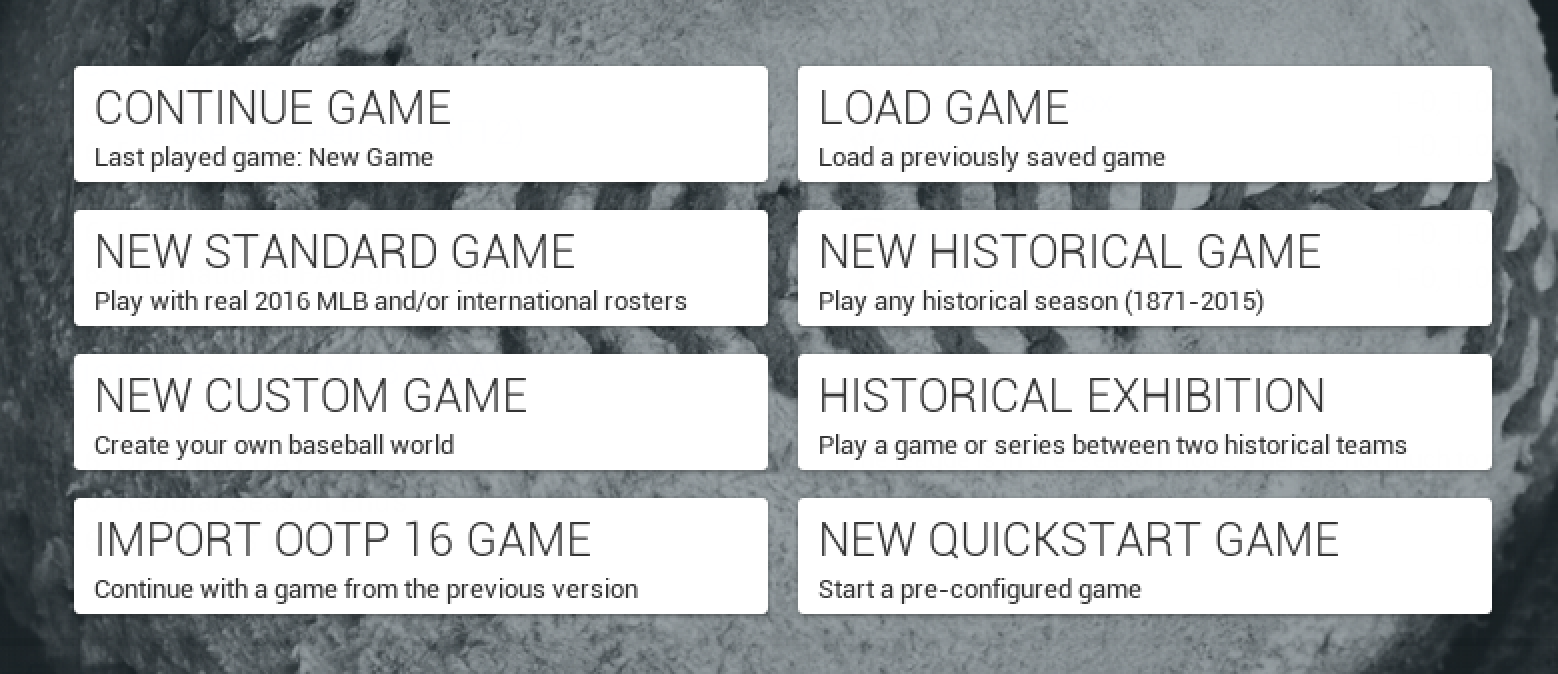
When you start OOTP 17, a well rated baseball simulation app, these are the main choices available on the first screen you see. Stumbling through the online manual on my first day of exploration, I found the choice that would enable me to begin playing with the current MLB teams: “New Standard Game.”
Menu on OOTP Home Screen
What I did not know at the time was that in “New Standard Game” OOTP defines game differently than I do, something I did not discover until later. I expected its “game” to mean a typical baseball game, the type I watch on TV. But that’s not how OOTP defines it. It defines it in a broader sense, more like the “game of baseball,” but even then the game played in the Major Leagues differs from the Little League game, and both of them are not identical to the game played in the Gulf Coast League.
In its online documentation’s section titled “Game Universe Terminology,” the closest definition I found was of a “saved game,” which is
one ‘universe’ of baseball in OOTP. A saved game could contain one league, five leagues, one league with multiple ‘subleagues,’ or any other combination of leagues and subleagues.
A “universe” of baseball is such a broad term I’m not going to try to define it; instead I re-viewed “New Standard Game” as meaning “New Game Universe.” And since then, I’ve slowly been learning what that universe includes — and how to play an MLB game the OOTP way.
Based on their past draft performance, I don’t have high expectations about how the New York Giants will do in the 2016 draft. They have two many needs: defense line, safety, linebacker, offensive line, end, running back. So where do they start? With the “best” player available? Unfortunately, since Joe Don Looney they have not been that good at identifying them. For example, in 2012 their pick of David Wilson seemed to be an overreaction pick after the Bucs selected Doug Martin the pick before. Both Bobby Wagner and Lavonte David were still available, but then the Giants rarely draft linebackers in the first few rounds. (Who’s behind that thinking?) Further, in 2016, the top two linebackers, Jaylon Smith and Miles Jack, are both recovering from significant injuries, which should make them even less attractive to the Giants. They need help NOW. The next highest-rated linebacker, Leonard Floyd, is rated #13 on NFL.com’s top 100, but he only weighs 231, NFL.com labelling him “painfully thin.” In 2015, the Giants were the ninth worst against the run, so if they were going to draft a linebacker, they need a run stopper.
Safety? They are as weak at safety as Popeye is without his spinach. NFL.com gives their top-rated safety, Duke’s Jeremy Cash, only a 5.68 rating. That is not a rating worthy of a #10 pick. Further, NFL.com states that “Cash is much too stiff to be asked to make a living in coverage and any team considering him will likely view him as a box safety,” something the Giants do not need to spend a high pick on. So, let’s eliminate the safety position as the one to spend a top pick on.
A recent article on nj.com had this title: “Giants’ late-round draft record among NFL’s worst with Jerry Reese at GM.” The article was a followup to a question to Giants GM Jerry Reese about the Giants’ poor draft performance in the lower rounds: “Have you researched that? Do you know that for a fact?” Reese said. “OK, until you know that for a fact, then I don’t think you should say that. That’s just my opinion. If you know that for a fact, then you can tell me that. But give me the facts on that.”
The author of the article, Jordan Raanan, did just that. Followup research revealed that the Giants ranked near the bottom from 2007-13 in Rounds 3-7. (See Raanan’s article for the details.)
But how could Reese NOT know that? Doesn’t his department gather data on their draft performance versus the other NFL teams? If they do, isn’t he aware of it? Worse, if they don’t, why not?
Here are some of the Giants recent draft busts:
Damontre Moore (Round 3)
Adrien Robinson (Round 4)
Brandon Mosley (Round 4)
Marvin Austin (Round 2)
Jerell Jernigan (Round 3)
James Brewer (Round 4)
Phillip Dillard (Round 4)
Clint Simtim (Round 2)
Ramses Barden (Round 3)
Here are some of their recent draft misses:
In 2013 they drafted Damontre Moore in Round 3. Still available when they drafted:Logan Ryan and Jordan Reed.
In 2012 they drafted Reuben Randle in Round 2. Still available when they drafted: Dwayne Allen and Mohamed Sanu.
In 2012 they drafted Jayron Hosley in Round 3. Still available when they drafted: Lamar Miller and Bobby Massie.
In 2012 they drafted Adrien Robinson and Brandon Mosley in Round 4: Still available when they drafted: Josh Norman and Alfred Morris.
 Bats and Stats