Trading Noah Syndergaard is a high-risk move for Mets

The headline for Mike Puma’s New York Post article reads “Brodie Van Wagenen can’t afford to make wrong Noah Syndergaard call.” But what is the “right call”?

That depends on how much Syndergaard is worth.

Only 26, he should be worth more than Cano and Diaz combined, and look at what the Mets gave away to get those two.

In his five seasons with the Mets, Syndergaard has pitched more than 600 innings, has a 44-27 record, and a strikeout-to-walk ratio of 4.59. Let’s see how those numbers –— and others –— stack up against other Mets pitchers, both current and past, after 107 games, which is how many Syndergaard has pitched.

In his career, in 106 starts, Syndergaard has pitched 644 innings. That is the 9th-most among all Mets pitchers after 107 games. And that includes the 2017 season when, because of injury, he pitched only 30.1 innings. If, in the 2017 season, he had pitched as many innings as he averaged in his 2015, 2016, and 2018 seasons –— just over 164 innings pitched, then for his first four seasons he would have pitched over 804 innings, which would have advanced him to the top of the list, replacing Doc Gooden who pitched 803 innings and moving him ahead of Tom Seaver, who pitched 799.2 innings.

In comparison, Jacob deGrom ranks 7th with 680.2 and Zack Wheeler ranks 12th in innings pitched with 631. So, Syndergaard has pitched 44.2 fewer innings than deGrom but 13 more than Wheeler. Among the other, current Mets starters, Steven Matz has pitched only 91 games with 87 starts and Jason Vargas played his first two seasons for Florida.

Syndergaard’s career winning percentage of .620 is 5th-highest among all Mets starters with at least 40 wins. Only Gooden, Seaver, Darling, and Koosman are ahead of him, with Gooden the leader with a .753 winning percentage.

Among Syndergaard’s teammates, deGrom has a winning percentage of .584. Wheeler’s is .535 and Matz’s .455.

Besides innings pitched and winning percentage, another measure of a pitcher’s value is strikeout-to-walk ratio.

How important is strikeout-to-walk ratio?

Kerry Miller wrote that

“Strikeout rate per inning has changed drastically throughout the history of the game, but strikeout-to-walk (K/BB) ratio is a rather consistent measure of a pitcher’s effectiveness. Whether you’re talking 1889, 1936 or 2014, a 2.5 K/BB ratio is strong, anything better than a 3.0 is great and pitchers above 4.0 are just plain lethal.”

In Web article “Major League Baseball’s Top 10 Starting Pitchers of All Time”

In 2019, Syndergard’s strikeout-to-walk ratio of 5.44 is 7th-best among all MLB pitchers with at least 80 innings pitched.

During Syndergaard’s career, he has struck out 697 batters while walking only 152 for a SO/BB ratio of 4.59. It is not only the highest among current Mets starters, it is the highest in Mets history for all starters with more than five starts. The 2nd-highest among all Mets is deGrom’s 4.15. The only other current Mets starter in the top 20 is Steven Matz, whose SO/BB ratio of 3.04 ranks him 20th.

Among past Mets with at least 100 starts, filling out the top 5 are Matt Harvey with a SO/BB ratio of 3.61, Doc Gooden with a 3.29 ratio, and Tom Seaver with 2.82.

When it comes to trade value, Syndergaard should be worth as much as Chris Archer.

In his first 107 games, Archer pitched 631.0 innings, 13 fewer than Syndergaard, had a winning percentage of .473, 147 points lower than Syndergaard’s .620, and had a SO/BB ratio of 2.90, noticeably lower than Syndergaard’s 4.59. When traded in 2018, for Archer the Rays got from the Pirates outfielder Austin Meadows and right-handers Tyler Glasnow and Shane Baz, all well-regarded prospects.

Others also rate Syndergaard highly.

Tim Britton of theathletic.com calls Syndergaard “an ace-caliber pitcher under control for 2 1/2 more seasons.”

Abby Caldwell of the Blog Red Machine wrote that

“Syndergaard is already very good and will likely come with a huge price tag in any trade. . . . the Reds would probably have to offer up at the very least an outfielder such as Jesse Winker, probably a bullpen arm like Michael Lorenzen, and a top prospect like Jonathan India.”

In Web article “Cincinnati Reds: Trading for Noah Syndergaard would be worth the cost”

And then Caldwell added, “I wouldn’t be opposed to them making a deal like this at all.”

Adam Weinrib on 12up.com wrote with regard to the Twins trading for Syndergaard, “they should make this move 10 out of 10 times, regardless of cost” in the article, “Twins Must Bite the Bullet and Pay High Price for Noah Syndergaard.”

If Syndergaard is traded, it will the Mets first major deal since the Cano/Diaz debacle, one in which Puma said the Mets got

“an underperforming 36-year-old second baseman, who is under contract through 2023 and a closer who still hasn’t shown he can handle the stress that comes with pitching in New York.”

Mike Puma in Web article “Brodie Van Wagenen can’t afford to make wrong Noah Syndergaard call.”

That deal, coupled with the Mets trades for Broxton and Font, has raised questions about the Mets’ ability to properly vet players, questions the organization has yet to adequately answer.

To prevent a fan rebellion, the Mets will need to get a return as good as the one the Rays got last July when they traded Chris Archer to the Pirates.

Finally, the cost of keeping Syndergaard must also be taken into consideration.

If he continues to pitch as well as if not better than he has up to the point when he reaches free agency (2022), can we really expect the Wilpons to meet his salary demands then, which could be for even more money than deGrom got?

If the Mets believe they can re-sign Syndergaard by the time he reaches free agency, they should keep him. If they have doubts, they should trade him when his value is high, which it is now. However, trading Syndergaard involves risk, one the Mets should only take if it includes multiple, highly ranked MLB prospects, with one preferably comparable in skill to the Padres’ shortstop Fernando Tatís.


Main data source: https://www.baseball-reference.com/tiny/S5g9q
Search criteria: From 1962 to 2019, playing for NYM, as starter, in first 107 games, (requiring IPouts>=3), sorted by greatest number of games in all seasons matching the selected criteria.
New York Mets All-Star Game Participation

This season, three Mets have been selected for the 90th All-Star game: Jacob deGrom, Jeff McNeil, and Pete Alonso, which is more than in 2017 and 2018 combined. In 2017 and in 2018 only one Met was chosen. Further, though McNeil has played multiple positions this season, he is listed on the All-Star roster as a second baseman, a position he has played only 22 times: in 2019, he has primarily played in 2019 in the outfield.

Since the Mets began in 1962, the team’s players have been selected for the All-Star team 121 times. The first Mets player selected, in 1962, was Richie Ashburn. In that year there were two All-Star games, one on July 10, which the National League won, and the other on July 30, which the American League won. Ashburn did not start in either game. Willie May started in centerfield in both games. He did not play in the first game, but in the second game, as a pinch-hitter, he singled in the seventh inning and scored a runner. 1962 All-Star Game Box Score by Baseball Almanac

Only four Mets have started an All-Star game in centerfield: Willie Mays in 1972, Lance Johnson in 1996, and Carlos Beltran twice, in 2007 and 2008. In the 1996 game, Johnson had 3 hits in 4 at-bats. That season, he led the National League in hits with 227, in 1996, in singles with 166, and in triples with 21. Despite his great season with the Mets, in August 1997 they traded him to the Cubs along with Mark Clark and Manny Alexander for Brian McRae, Mel Rojas, and Turk Wendell.

Besides Beltran, only 28 other Mets were selected for the All-Star game more than once while playing for the Mets. Leading the group is Tom Seaver who appeared in nine games. Among the others selected multiple times are Mike Piazza, Darryl Strawberry, and David Wright, all selected seven times.

The most Mets selected in one season to the All-Star team is six. That occurred in 2006. Somewhat surprisingly, during the 1969 season only three Mets made the All-Star team — Cleon Jones, Jerry Koosman, and Tom Seaver and, the following season, only two made it — Bud Harrelson and Tom Seaver.

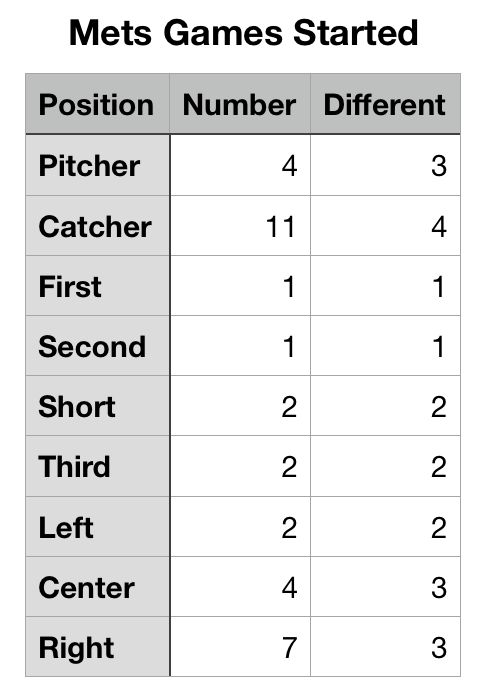
Finally, whereas four Mets pitchers have started an All-Star game, only one first baseman did, Keith Hernandez, one second baseman, Ron Hunt, two shortstops, Bud Harrelson, and Jose Reyes, and two third basemen, Howard Johnson and David Wright.

The table below show how many times since 1962 a Mets player has started in an All-Star game by position. The “Different” column indicates how many different players started. For example, though Mets pitchers have been the starters in All-Star games four times, one pitcher (Dwight Gooden) started twice. The other two were Tom Seaver and Matt Harvey.

All-Star Games in which Mets player started, by position

Cano’s swing could be lowering his batting average

It’s being written that Mets second baseman Robinson Cano is not as good a hitter as he has been in the past. Here is some evidence that supports that assertion:

  • He never had an OBP under .300. His previous low was .305 in 2008. In 2019 it is .277. His lowest batting average was .271 in 2008. This season he is hitting .228.
  • His lowest slugging percentage was .410 in 2008. This season, it is .369.
  • His OPS is .646. He never before had an OPS below .700.

Is that evidence sufficient for someone to conclude that Cano is not the same hitter he was in previous seasons? Not yet.

Cano could be unlucky.

His xBA (Expected Batting Average) for 2019 is .268, 40 points higher than his actual batting average; however, that is under his prior season low of .271 in 2008.

In addition, this season, his BABIP is .270 (43 for 159). Fewer batted balls are resulting in hits. Only twice before (2008 and 2017) in his 15 seasons playing in the majors did he have a BABIP below .300.

Batting Average on Balls in Play (BABIP) is a statistic which measures how often non-home run batted balls (often called ‘balls in play’) fall for hits.

FanGraphs

“A ball is ‘in play” when the plate appearance ends in something other than a strikeout, walk, hit batter, catcher’s interference, sacrifice bunt, or home run,” according to FanGraphs.

The 2019 League average BABIP is .296, so Cano’s is 26 points or about 10 percent less than it.

Is he just having back luck this year? No. Cano is having trouble at the plate with balls he is not putting into play.

  • His K/PA ratio of .195 is the highest in his career. For his career, it is .126. Plus, his K% is 19.2%, the highest one in the last five seasons.
  • His HR/PA ratio of .018 is the lowest of his career, and this is in a season when so many homers are being that the reason why is under investigation. For his career, it is .035.
  • His BB/K ratio of .302 is his lowest since 2005. For his career, it is .522.

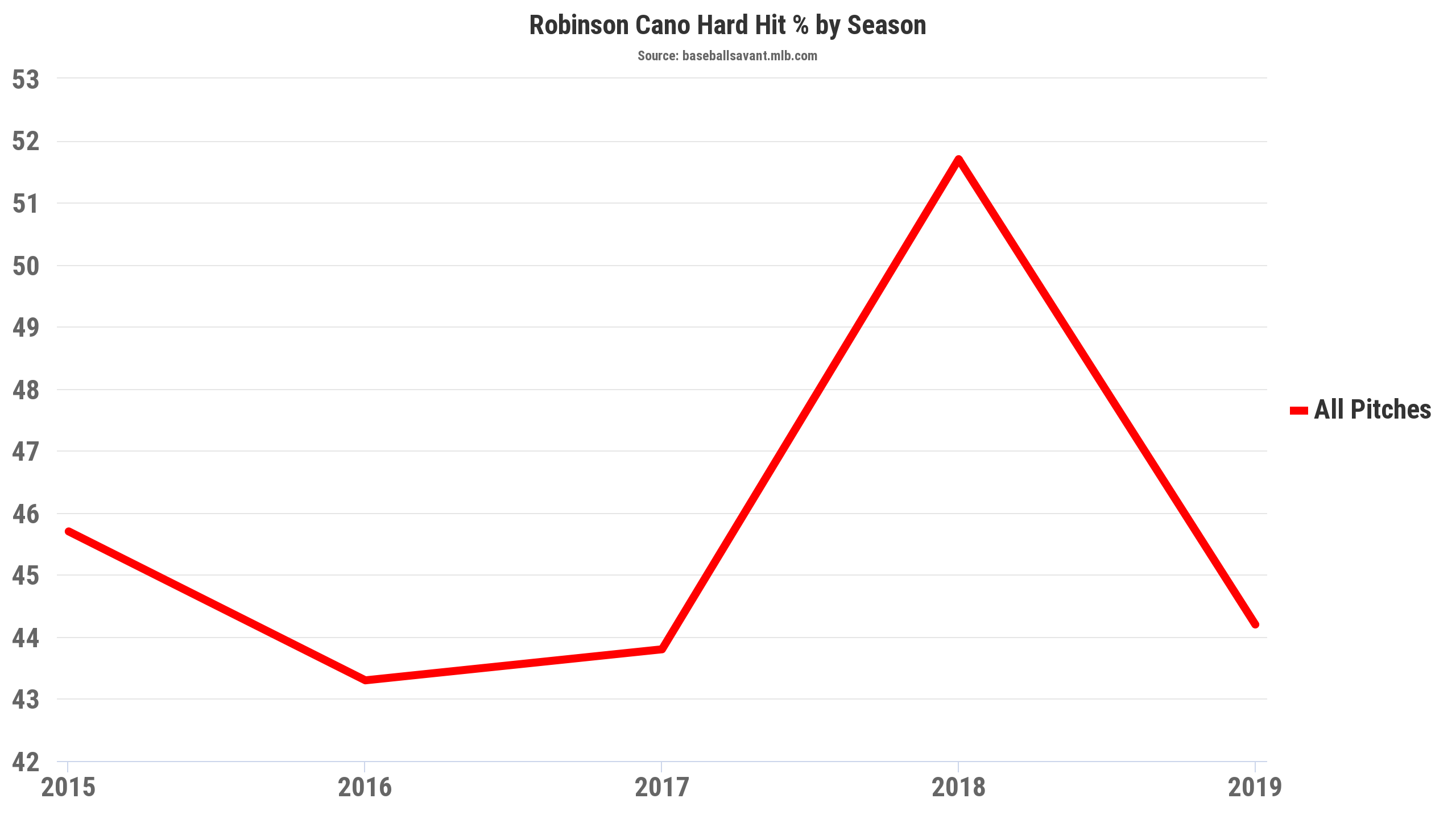
Is he still making solid contact? “The harder a ball is hit, the more likely it is to fall in for a hit,” according to FanGraphs. When Cano is hitting the ball, his average Exit Velocity of 90.6 mph is close to his average of of 90.8 mph from 2015 to today; however, his Hard Hit % is on the decline even though.

A hard-hit ball is one hit with an exit velocity of 95 mph. This season he has hard hit 72 balls, ranking him 114th in MLB.

Source: Baseball Savant

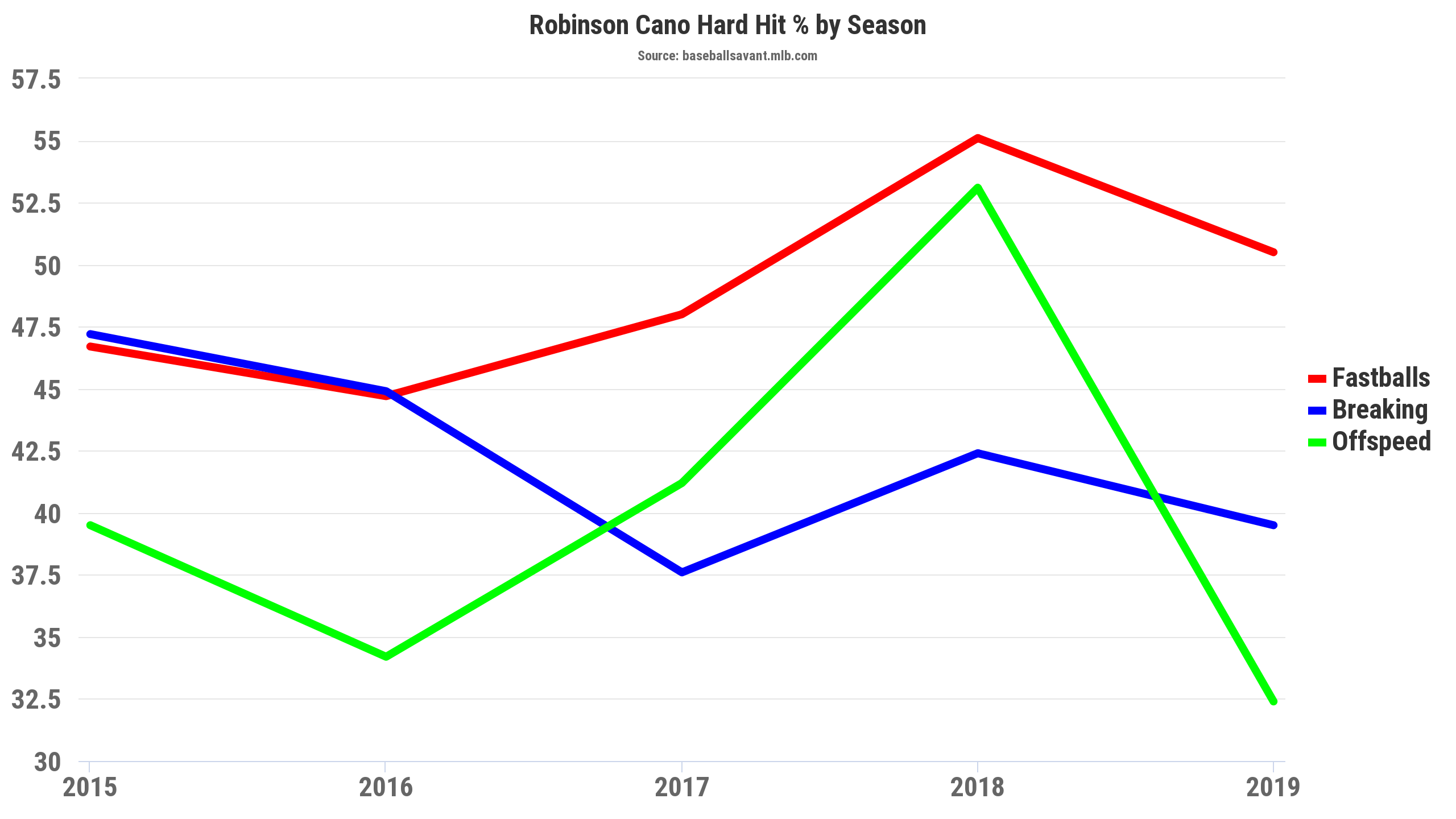
He is having the most trouble hitting off-speed pitches hard.

Source: Baseball Savant

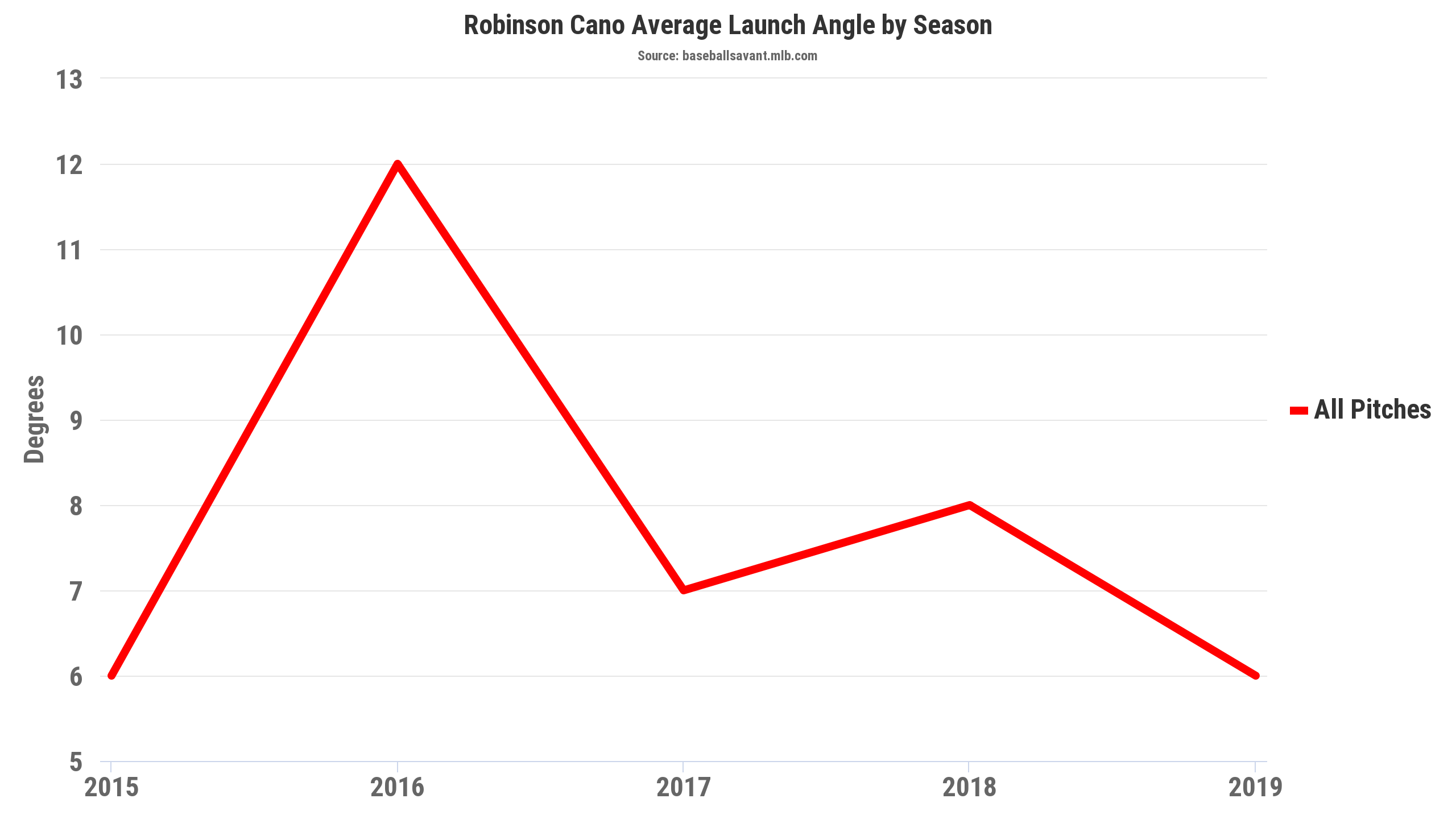
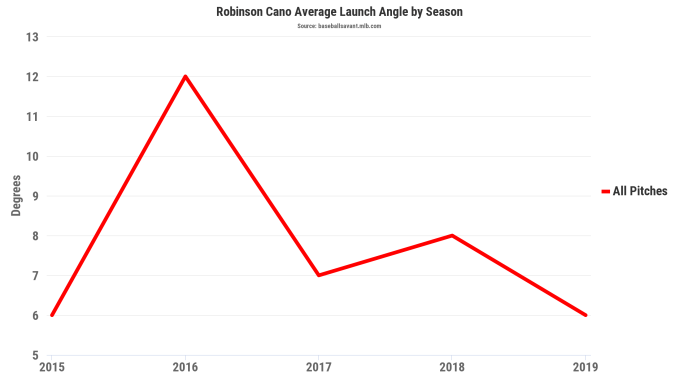
Other significant changes are these: (1) His GB% is the highest it has been since 2015, and (2) his average Launch Angle is the lowest it has been since 2015.

Source: Baseball Savant

Further, since 2018 he is getting much less loft on breaking pitches, and since 2016, the loft he is getting on fastballs has shown a steady decline.

Source: Baseball Savant

Given that his exit velocity has not slowed, could his launch angle drop be intentional?

In 2019, 52.1% of his batted balls were ground balls. His batting average on ground balls is .165 (14 for 85) where the League average is .240 or 75 points higher. In comparison, his batting average on fly balls is .222 — the League average is .302, and on line drives it is .574 where the League’s is .630.

The table below presents Cano’s batting average by launch angle.

Launch AngleAverage
>= 30°.083
20° to 30°.381
10° to 20°.692
0° to 10°.444
<= 0°.108
<= -10°.044

When he is either swinging down or with an attack angle above 30°, Cano is barely hitting .100 at best. Therefore, if he reduces the number of times he swings downward and tries to keep his launch angle within the 0° to 30° range, he should see improvement in his batting average. However, until his batting average starts rising it could help him, pressure-wise, if he bats lower in the order.

Statcast School: Hardest Hit Ball to 3B

Source: Pixabay

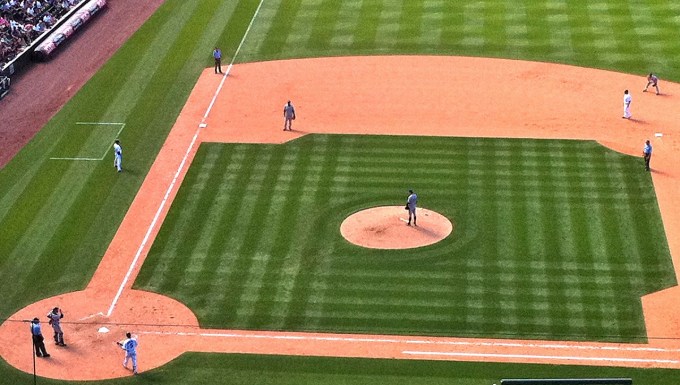
When a third baseman is playing close to the bag, he is not much more than 90 feet away from the batter. Only the pitcher, and sometimes the first baseman, is closer. A ball hit to third base can exceed 100 miles per hour. At 100 mph, that is 146.7 feet/second, so it will reach the third baseman in fewer than one second. Not much time to react.

Who has hit the hardest ball (ground ball or line drive) to third base this season? Here is how to find that out.

Statcast Search Selections
1. Batted Ball Type: both Line Drive and Ground Ball
2. Batted Ball Location: Third Base
3. Season Type: Regular Season
4. Season: 2019
5. Player Type: Batter
6. Metric Range: Exit Velocity
7. >=: 114
8. Min # of Total Pitches: None
9. Min # of Results: None
10. Group By: Player Name
11. Sort By: Pitches
12. Sort Order: Desc
13. Min PA: None
14. Change Total Pitch Parameters: None

Results
Two batters qualified: Maikel Franco and C. J. Cron. On April 25, 2019 Franco hit a 114.1 mph per hour line drive at Marlins third baseman Martin Prado. The ball traveled 138 feet. On June 23, 2019, Cron hit a 114.7 mph grounder at Royals third baseman Hunter Dozier. Its distance: 122 feet. Thus so far this season (as of games thru June 23), C. J. Cron has hit the hardest ball to third base.

Two Research Questions (Use Statcast to find answers)
As of games through June 23, 2019, how many batters hit a ball at least 114 mph? Who hit the one with the greatest exit velocity? How fast was it?